Blog
Custom Playground Equipment Manufacturer: Design Guide

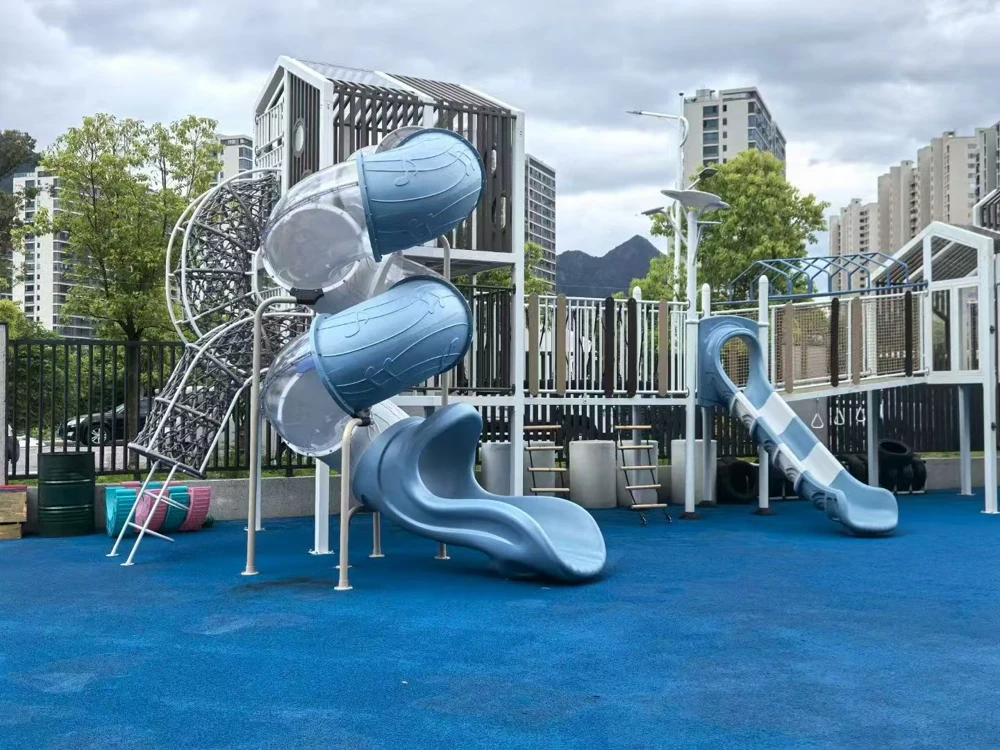
A custom playground should begin where the standard catalog stops fitting the site. That might happen because the footprint is unusual, the project needs a landmark identity, the owner wants a theme that cannot be expressed with standard equipment, or the activity route has to work around existing circulation. For contractors, designers and developers, the important question is not whether a manufacturer says it can customize. It is whether the manufacturer can turn a concept into a buildable, reviewable equipment system.
Xinjiu develops custom outdoor non-powered playground equipment in Wenzhou and supports projects with 2D layouts, 3D visualization, theme development, activity configuration, OEM/ODM manufacturing and export coordination. Its custom playground manufacturing process is designed around the site and project brief rather than around a fixed model list.
A custom playground equipment manufacturer should define what is actually being customized
Customization can range from simple visual changes to a new equipment system. A color adjustment may leave the structure and play route unchanged. A themed facade may alter the appearance while keeping the core equipment familiar. A truly non-standard playground can change tower locations, bridge connections, slide routes, climbing elements and the overall footprint.
Industry custom-design processes often move from concept and visualization into technical development before manufacturing. That sequence matters because visual ambition has to be translated into dimensions, materials, connections and equipment relationships that can be produced and installed.
When a visual theme is enough—and when the structure needs to change
A property project may want a nature-inspired playground that feels integrated with landscaping. If the available space already suits a standard combination system, visual customization may focus on color, roof forms and themed details. Xinjiu’s Nature Theme Combination Slide shows this type of coordinated visual direction with leaf-style roofs and green slide elements.
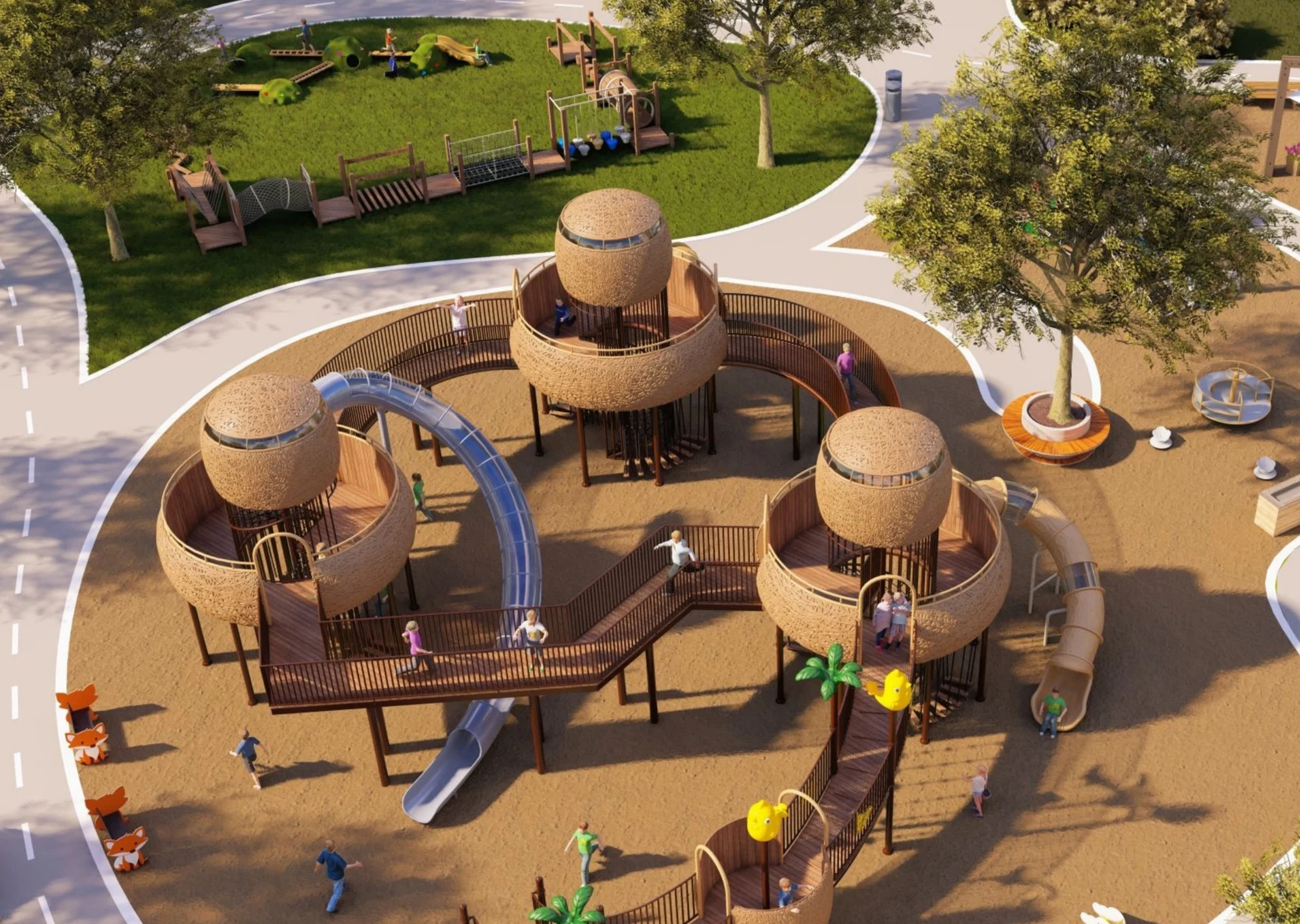
A destination project may ask for something more distinctive, such as the Bird’s Nest Custom Playground. Its sculptural towers, elevated bridges and enclosed slides create a play route that is inseparable from the form of the structure. In that case, changing the concept can change the engineering and the equipment layout, so the project should be treated as a non-standard system rather than a decorated standard product.
Use the 3D concept to test scale and relationships, not just appearance
A 3D rendering is useful because it helps different stakeholders see the same idea. But it should do more than make the playground look attractive. The project team should use it to review relative scale, the relationship between towers, the direction of slide exits, how climbing routes connect and how the structure sits in the wider site.
Xinjiu’s project pages describe free 2D layout and 3D rendering support. For a custom playground, those drawings can become a shared decision point between the owner, designer and manufacturer before the order moves into production.
Custom playground manufacturing needs a site brief before it needs a product name
A manufacturer cannot develop a useful custom system from a theme word alone. “Space,” “forest” or “castle” may describe the visual direction, but the manufacturer still needs site dimensions, intended users, activity priorities and the destination market.
That distinction becomes especially important when a concept has to fit existing architecture. A playground beside a clubhouse, inside a landscaped courtyard or along a narrow public path may need the same theme expressed through very different geometry. The design team should therefore treat site constraints as part of the creative brief rather than as a problem to solve after the concept has already been approved.
Xinjiu asks buyers to provide the site plan or usable dimensions, target age groups, project type, preferred theme, reference images, destination, budget direction and timeline. That information helps narrow the design problem before the team decides how the playground should look.
A narrow site may need a linear route instead of a central landmark
Some footprints are long and narrow rather than open and square. Xinjiu’s Linear Custom Play Circuit organizes bridges, panels and slides along a clear route, making it easier to use a constrained site without forcing a bulky central structure into the space.
For a contractor renovating a narrow community strip or school edge, this type of route can be more practical than a landmark tower. The custom design problem is therefore not always “make it bigger” or “make it more dramatic.” Sometimes it is about adapting the play sequence to the geometry that already exists.
A tall public space can justify a stronger vertical concept
The opposite condition is a site with enough open area and visibility to support a taller feature. Xinjiu’s Architectural Spiral Slide System uses tall enclosed slides and geometric frames to create a more vertical identity. That direction can make sense in destination parks or public spaces where the playground is expected to be seen as part of the architecture.
It would be excessive in many small school or preschool settings. A custom manufacturer should therefore be willing to explain when a concept is not appropriate for the site, not simply prove that it can be manufactured.
The activity route matters as much as the custom sculpture
A playground can look unique and still provide a weak play experience if the activities are poorly connected. Multiple routes, choices and changes in challenge can make a custom structure more engaging than a single linear path.
The Spider Web Climbing Course creates a sculptural climbing challenge rather than a slide-led route. The Circular Net Climbing System uses a ring-shaped frame and three-dimensional rope network. These systems show that custom identity can come from the activity itself, not only from decorative forms.
Custom climbing should be considered in relation to the rest of the site
A high-visibility climbing system can become a destination inside the playground. If the same site also contains a large combination slide, the two structures should not compete for the same circulation zone or serve exactly the same activity purpose.
A landscape team can use the 2D layout to decide whether the climbing system becomes a separate challenge area, a transition between zones or the main focus. That spatial decision should happen before the final configuration is released for production.
Supporting products should reinforce the custom idea without diluting it
A custom landmark does not mean every item on the site also has to be custom. Smaller supporting products can be standard if they fit the activity plan. PE-panel spring riders, molded riders or balance elements may serve younger users around a larger themed structure without requiring the same level of development.
This can be useful for a project owner who wants the budget and design effort concentrated on one distinctive centerpiece while using simpler equipment elsewhere.
From approved concept to manufacturing, the custom decisions need to stay traceable
Once a custom design is approved, the project changes from an idea problem into a production problem. The buyer needs to know that the latest visual direction, equipment list, material choices and dimensions describe the same version.
Xinjiu’s stated workflow connects custom development with manufacturing, export preparation and project support. The company has operated since 1999 and its current pages describe an internal design capability for 2D planning, 3D visualization and non-standard development.
Materials should be confirmed against the final custom structure
Xinjiu’s range includes PE panels, molded plastic forms, timber structures, metal frameworks and rope networks. A custom playground may use several of those material families in one system. The buyer should therefore confirm the actual materials and finishes attached to the final design rather than rely on general product-family descriptions.
The company states that anti-UV, anti-corrosion and eco-conscious options can be considered according to the equipment type, environment and confirmed specification. For a custom order, the important phrase is “confirmed specification”: the project team should know which option applies to which component.
Destination requirements should enter the custom project before production drawings are frozen
Public-playground requirements vary by destination. ASTM F1487 covers public-use playground equipment within its scope and addresses areas including materials, performance, layout, installation and maintenance. Other product families, such as soft contained play, sit outside that scope. Buyers should therefore state the destination market and required documentation during design development.
A custom project is the wrong place to discover a major requirement after the equipment is finished. Xinjiu’s project brief asks for destination and certification needs, allowing those questions to be raised before manufacturing begins.
Two custom playground briefs that should lead to very different solutions
A landscape architect designing a nature-led public park
The architect may begin with a site plan, planting strategy and a desire for the playground to feel integrated with the landscape. A nature-themed custom system, timber climbing route or combination of both may fit that direction. The project team can use 3D views to test whether the equipment feels too dominant, too fragmented or properly connected to the surrounding paths.
In this scenario, customization is not just branding. It is about making the playground belong to the place.
A developer creating a recognizable destination feature
A developer may want a structure that is memorable enough to become part of the project’s identity. A Bird’s Nest, sculptural animal form, rocket concept or tall architectural slide system can answer that brief better than a low-profile standard set.
The custom process should then focus on what makes the form readable from a distance, how children move through it and how supporting activities extend the experience without cluttering the site. The manufacturer should help turn that ambition into an equipment package that can actually be produced and delivered.
What to approve before a custom playground enters the factory
| Decision | What should be clear |
|---|---|
| Site fit | Usable dimensions, circulation, major access points and the location of the custom structure |
| Play route | Towers, bridges, climbing elements, slides and the sequence between activities |
| Visual direction | Theme, major forms, colors and the elements that make the project distinctive |
| Product scope | Which elements are custom, which are standard supporting products and the confirmed quantities |
| Material direction | Materials and finishes attached to the approved components |
| Destination handover | Required project information, packing, logistics coordination and installation support |
Buyers can review Xinjiu’s manufacturing background to understand how design and production are connected, then compare the custom playground examples and supporting product families to decide which parts of the site actually need non-standard development.
Before a non-standard structure is released, the buyer should walk through the latest drawing as if the earlier concept no longer existed. If a tower was moved, confirm the bridge still reaches the intended route. If an enclosed slide changed position, check the new exit against the site circulation. If a climbing system became taller or wider, verify that the surrounding layout was updated rather than only the 3D view. If a themed panel was replaced, confirm whether the change is decorative or affects access, guard elements or the activity path. These are small review steps, but they make custom approval concrete.
A custom playground is successful when the project still makes sense after the render is gone: the footprint fits, the activity route is clear, the materials are confirmed and the final equipment can be manufactured and handed over without losing the original design intent. That is the practical standard for evaluating a custom playground equipment manufacturer. The custom playground supplier handover guide follows the same project from brief through delivery.