Blog
Commercial Playground Equipment Manufacturer: Project Planning Guide

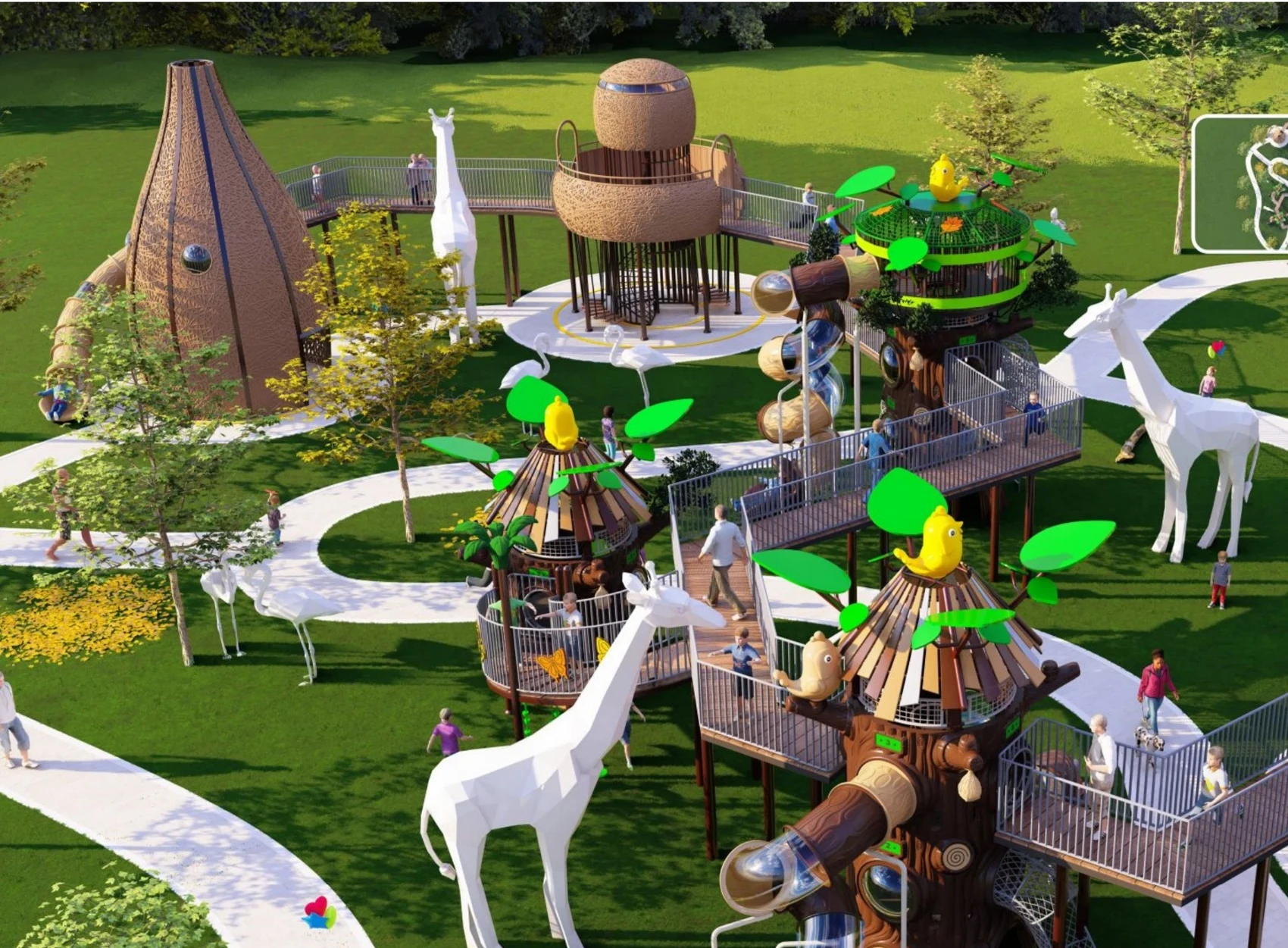
A commercial playground project should be judged by how well the equipment serves the site, not by how many features can be added to a quotation. Schools, residential developers, public parks, leisure destinations and commercial family venues all use playground equipment differently. For the buyer, the most useful role of a commercial playground equipment manufacturer is to translate those differences into a clear equipment plan before production begins.
Xinjiu manufactures indoor and outdoor playground equipment in Wenzhou and supports project development with 2D planning, 3D visualization, custom product development, OEM/ODM options, export preparation and remote technical guidance. Buyers can review the full playground equipment range for standard product directions, then move into the custom playground process when the site needs a stronger visual identity, an unusual footprint or a coordinated non-standard solution.
Commercial playground equipment manufacturing begins with the business use of the site
A school playground is not purchased for the same reason as a destination park. A residential community may need a reliable everyday play area close to homes. A leisure project may need a structure that becomes part of the attraction itself. These differences affect the scale, activity mix, visual identity and amount of project coordination required.
Current public-playground guidance also reinforces the importance of layout rather than isolated equipment selection. The CPSC Public Playground Safety Handbook highlights age separation, conflicting activities, sight lines, accessibility and supervision as key layout considerations. A manufacturer cannot decide those issues alone, but its equipment proposal should make them easier for the project team to review.
School projects often benefit from a balanced activity mix instead of one oversized structure
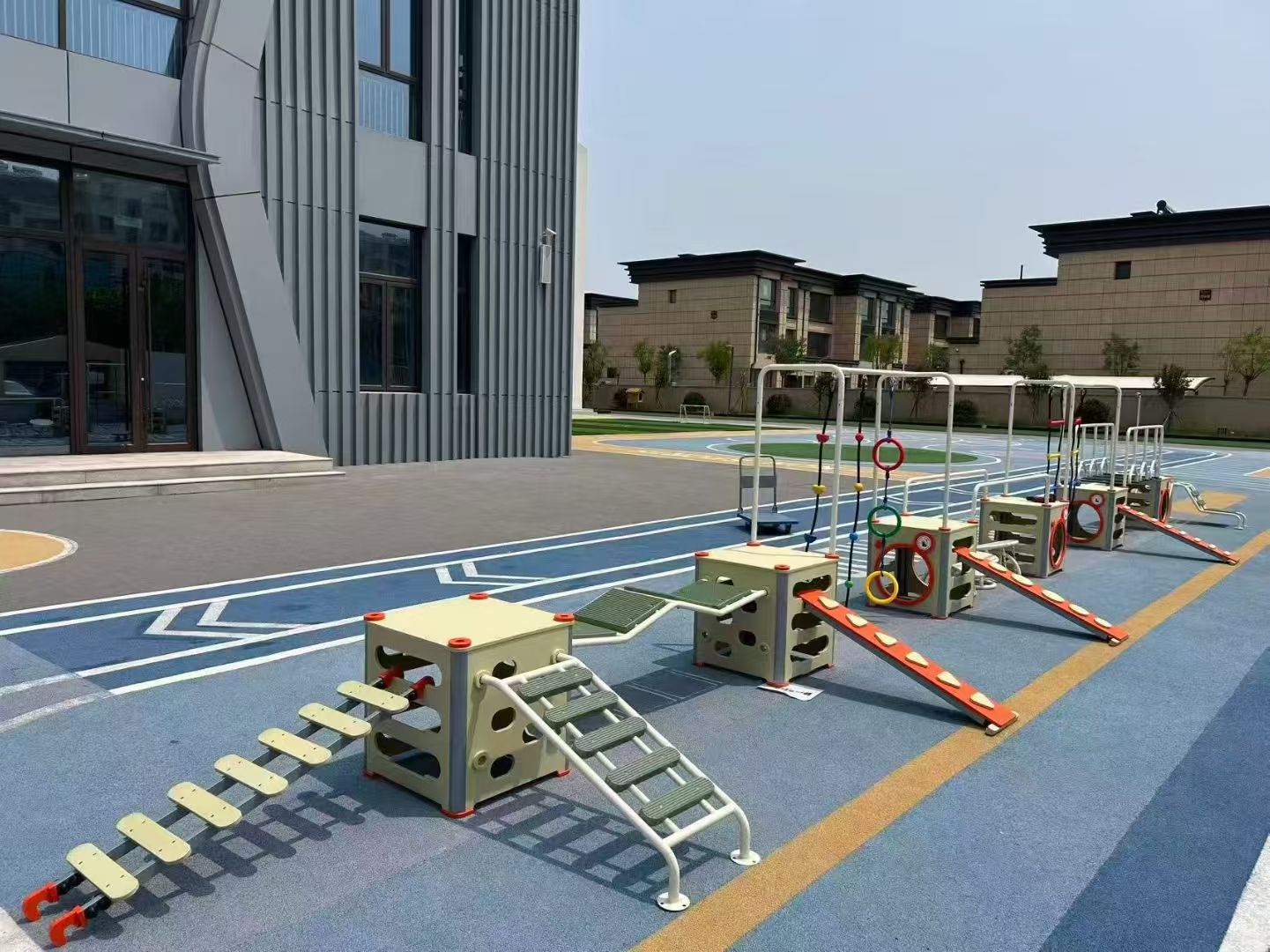
For a school, the project may need several types of movement without making the play area difficult to supervise. Xinjiu’s Modular Activity Training Course combines balance, stepping and crawl challenges in a compact sequence. The Timber Rope Bridge Playset adds climbing, crossings and imaginative play. A combination slide can provide a stronger central structure where the site can support it.
The useful design question is whether those activities complement one another. If the training course already provides repeated balance and movement tasks, the next structure should add a different play experience rather than duplicate the same challenge in another form.
Residential developments need equipment that works with everyday circulation
A residential courtyard is usually part of a wider landscape used every day by children, parents and other residents. Equipment should therefore be considered alongside paths, open areas and the visual character of the development.
The Nature Theme Combination Slide uses leaf-style roofs, green slides and connected towers, making it a natural starting point for a landscape-led residential project. A Dolphin PE Panel Spring Rider or a small balance activity can support younger users nearby. The manufacturer should help the buyer keep the central structure and supporting pieces proportionate to the available area.
For a property developer, the playground also has to read as one designed place rather than a group of unrelated catalog products. Theme, colors and equipment families become part of the wider site presentation.
Commercial playground equipment should be selected by capacity of use, not only visual scale
A large-looking structure does not automatically make a better commercial playground. The buyer should consider how users move through the equipment, whether several activities can operate at the same time and whether the surrounding area supports the intended circulation.
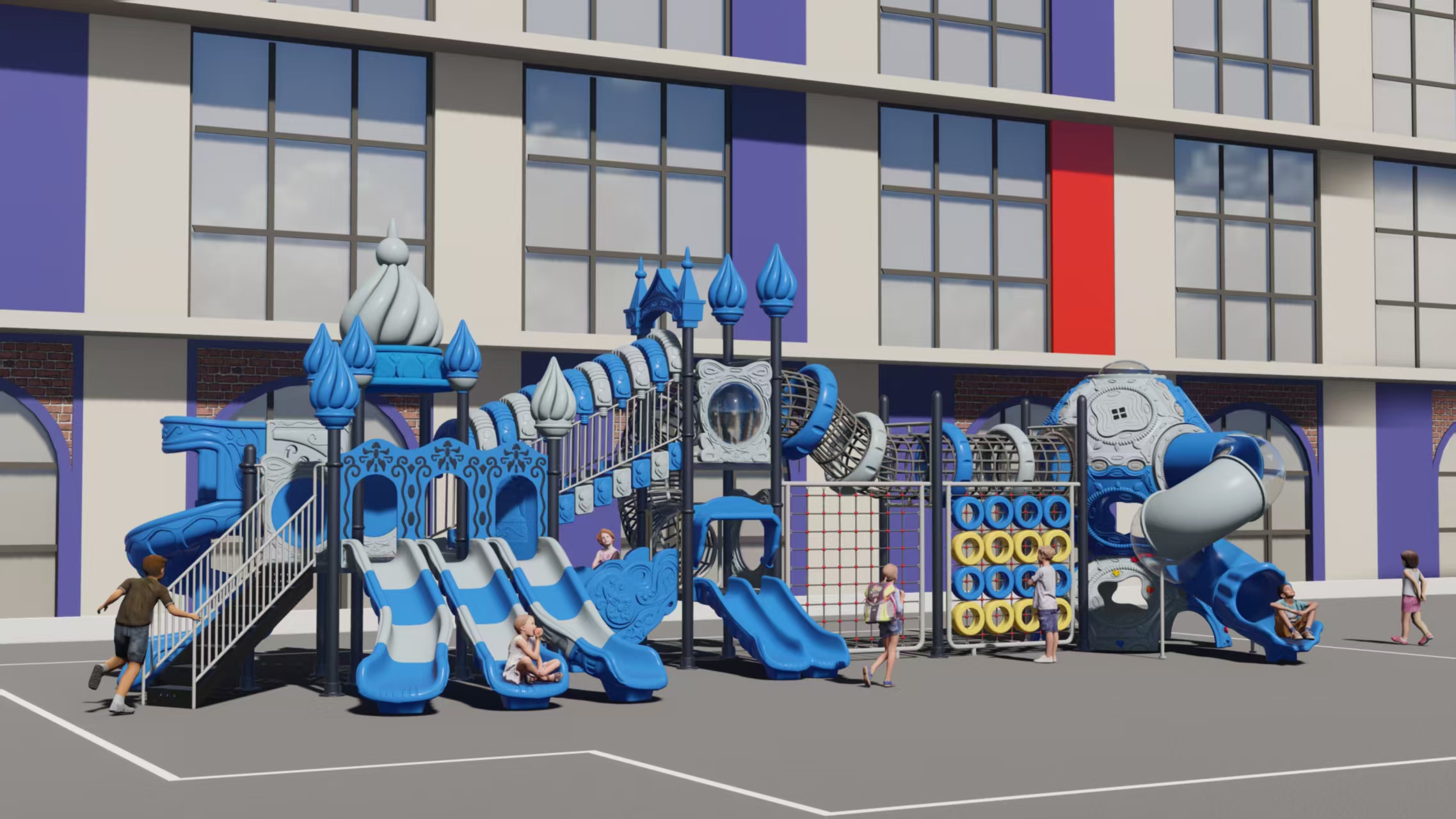
Xinjiu’s range provides several ways to build that activity depth. The Robot Theme Combination Playground includes linked towers, net connections and several slide exits. The Castle Theme Combination Slide combines multiple towers, climbing panels and open and enclosed slide routes. The Bird’s Nest Custom Playground uses elevated bridges and sculptural towers to create a longer landmark journey.
Combination playgrounds work best when several activities need to share one footprint
A commercial project with limited ground area may benefit from a structure that layers several activities together. A combination system can include climbing, elevated movement and slide exits without requiring each activity to stand alone as a separate product.
This can be useful in schools, communities and public parks where the site needs a recognizable center. It can be less useful when the project has enough area to create separate activity zones or when a very young user group would be better served by smaller-scale equipment.
Landmark structures make sense when visual identity is part of the commercial brief
Some commercial projects need more than a standard play route. A destination park, cultural tourism project or high-profile property development may want the playground to function as a visible landmark. Xinjiu’s Bird’s Nest, nature-themed custom systems and architectural spiral-slide concepts are examples of that direction.
For these projects, the manufacturer needs more than dimensions. The discussion may include the site’s design language, the intended theme, visual references, activity priorities and how the structure should be experienced from different directions. A 3D rendering is especially useful because owners and design teams often need to review the concept before the equipment is released for production.
A commercial playground equipment manufacturer should make customization measurable
“Custom” can mean very different things. Sometimes the buyer only needs a color adjustment. In another project, the equipment may require a new theme, changed activity combination, altered footprint or a completely non-standard structure.
Xinjiu states that it supports theme, color, function and configuration development as well as non-standard playground design. Its workflow includes 2D layouts and 3D visualization before production. For commercial buyers, this makes customization easier to discuss because the change can be tied to a drawing and an approved equipment scope.
Color changes are not the same as changing the play route
If a buyer changes the colors of a standard combination slide, the basic movement through the structure may remain the same. If a contractor changes the tower arrangement, bridge connection or slide position, the play route and site relationship may change as well.
That distinction is important when quotations are compared. A lower-priced proposal may simply contain fewer changes. A higher-priced proposal may include a more substantial redesign. The buyer should therefore compare the approved scope, not just the phrase “custom playground.”
Material families also shape the commercial character of the project
Xinjiu’s range includes timber, PE panels, molded plastic, metal frameworks and rope systems. Those materials do not create the same visual result. Timber play can sit more naturally in landscaped sites. Bright PE panels support graphic shapes and recognizable characters. Metal frames and rope systems can support larger climbing structures and architectural forms.
The Timber Climbing and Net Course, for example, creates a warmer, linear challenge route. The Spider Web Climbing Course uses a more sculptural net-and-frame form. Neither is universally better; they fit different project identities and activity goals.
Commercial buyers should evaluate project handover before the factory starts production
Commercial projects often involve several organizations: the owner, contractor, landscape team, distributor, installation team and logistics provider. That makes handover quality part of the equipment decision.
Xinjiu’s current project information includes production coordination, export documents, logistics coordination, installation manuals and online technical guidance. A buyer should confirm which parts apply to the specific order and which responsibilities remain with the local project team.
Destination requirements should be part of the design conversation
Different markets may require different standards, documentation and local approvals. ASTM F1487 addresses public-use playground equipment within its scope and covers areas including materials, performance, access, layout, installation and maintenance. It does not cover soft contained play. That means a commercial buyer purchasing outdoor equipment and indoor soft play should not assume that one requirement applies identically to both.
The buyer should state the destination market and certification or documentation needs during the project brief. Xinjiu’s inquiry process explicitly asks for destination and certification requirements, making that the right stage to identify what needs to be reviewed.
The final equipment list should match the drawings used by the project team
A project can change several times between concept and production. A developer may remove one structure, a school may change the age allocation, or a contractor may adjust the layout after receiving updated site dimensions. The final drawings and the final equipment list should therefore be checked together.
This is particularly important with custom structures because the final product may no longer match an early reference image. For standard products, the buyer should still confirm the model, quantity, material direction and finish used for the actual order.
Three commercial project scenarios require three different equipment strategies
| Commercial setting | Strong starting point | Main procurement question |
|---|---|---|
| School or kindergarten | Activity course, timber playset, combination slide | How can the site support different activity levels while remaining easy to supervise? |
| Residential community | Nature or Robot combination system with smaller supporting play | How does the playground fit everyday circulation and the wider landscape? |
| Destination or leisure project | Bird’s Nest, architectural spiral slide or other custom landmark | Does the equipment create enough visual identity and activity depth to justify a custom route? |
These scenarios should not be treated as fixed formulas. A small destination project may use standard equipment well, while a flagship residential project may justify a custom landmark. The point is to begin with the commercial use of the site rather than with a predetermined product family.
What distributors should ask a commercial playground manufacturer before adding a new product family
A distributor needs products that can be explained and sold consistently. Before adding another range, it helps to ask whether the products are repeatable individual items or project-specific systems.
- Spring riders: useful as compact products with clear individual identities, such as Horse, Frog, Airplane, Deer, Car and Dolphin models.
- Combination slides: stronger for site-led projects where the buyer needs several activities in one structure.
- Timber systems: useful where a natural visual direction matters and the site can support climbing and bridge activity.
- Custom landmarks: best treated as project development rather than simple stock, because drawings and site information influence the final result.
- Activity courses: useful for schools and supervised movement areas where the sequence of balance and coordination tasks is part of the brief.
A distributor who separates these routes can avoid asking every customer for the same information. A repeat rider order does not need the same design process as a custom destination playground.
How Xinjiu positions manufacturing around commercial projects
The Xinjiu company overview describes a Wenzhou-based manufacturer established in 1999, with design and manufacturing connected in one project workflow. The company supports contractors, distributors, project owners, schools and communities with custom outdoor equipment, combination slides, climbing systems and related play products.
That positioning is most useful when the buyer uses it as a project process rather than a slogan. Share the site, users, destination, preferred equipment direction and practical constraints. Review the layout and visual direction. Confirm materials, quantities and the final product list. Then align packing, export and installation information with the approved scope.
For a commercial buyer, the strongest sign of a useful manufacturer is not how many product photos it can send. It is whether the site plan, equipment selection, customization decisions and delivery handover remain connected from the first brief to the final order. The commercial playground supplier guide looks at the same project from the multi-party purchasing side.