Blog
Playground Equipment Supplier: Building a Coordinated Project Order

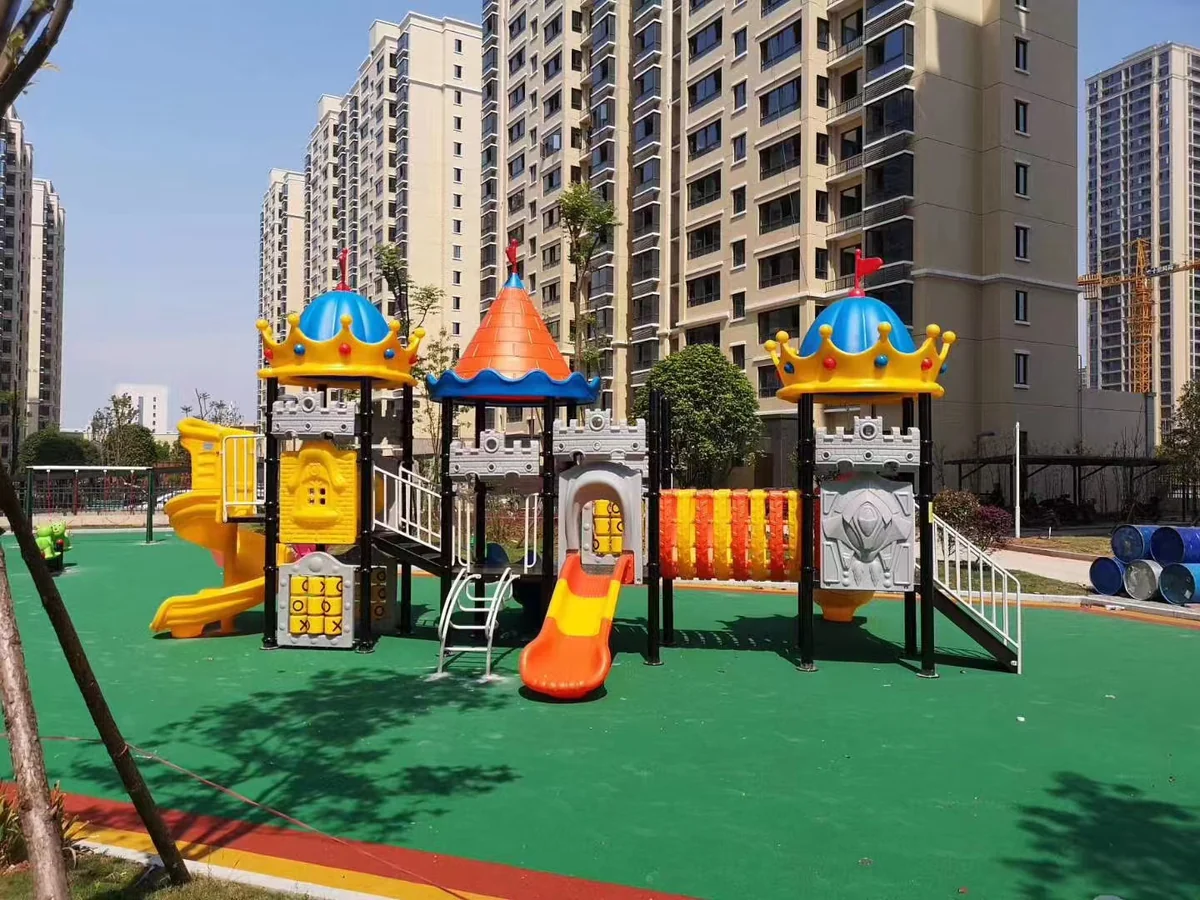
A contractor who needs one spring rider can buy by item. A contractor who needs an entire playground cannot. For a school, residential community, public park or indoor family venue, the useful question is whether a playground equipment supplier can coordinate several product families around one project brief. That means aligning the site, users, equipment mix, customization, documentation and delivery scope before production. Xinjiu’s current range gives buyers several starting points, from indoor soft play and outdoor playground categories to custom playground development for sites that need non-standard structures.
For a real B2B order, variety is only useful when it is organized. A supplier may offer combination slides, timber structures, climbing systems, spring riders, obstacle courses and indoor soft play, but the buyer still needs to know which pieces belong together, which require site-specific planning and which can be handled as simpler repeat items.
A playground equipment supplier should start with the project, not the catalog
Catalog browsing is useful for visual direction, but the first commercial conversation should establish the project conditions. Xinjiu asks buyers for the available site dimensions, intended age groups, project type, destination market, preferred style, quantities and target timeline. Indoor projects also benefit from clear ceiling height, column positions and entrances because those conditions directly affect the usable layout.
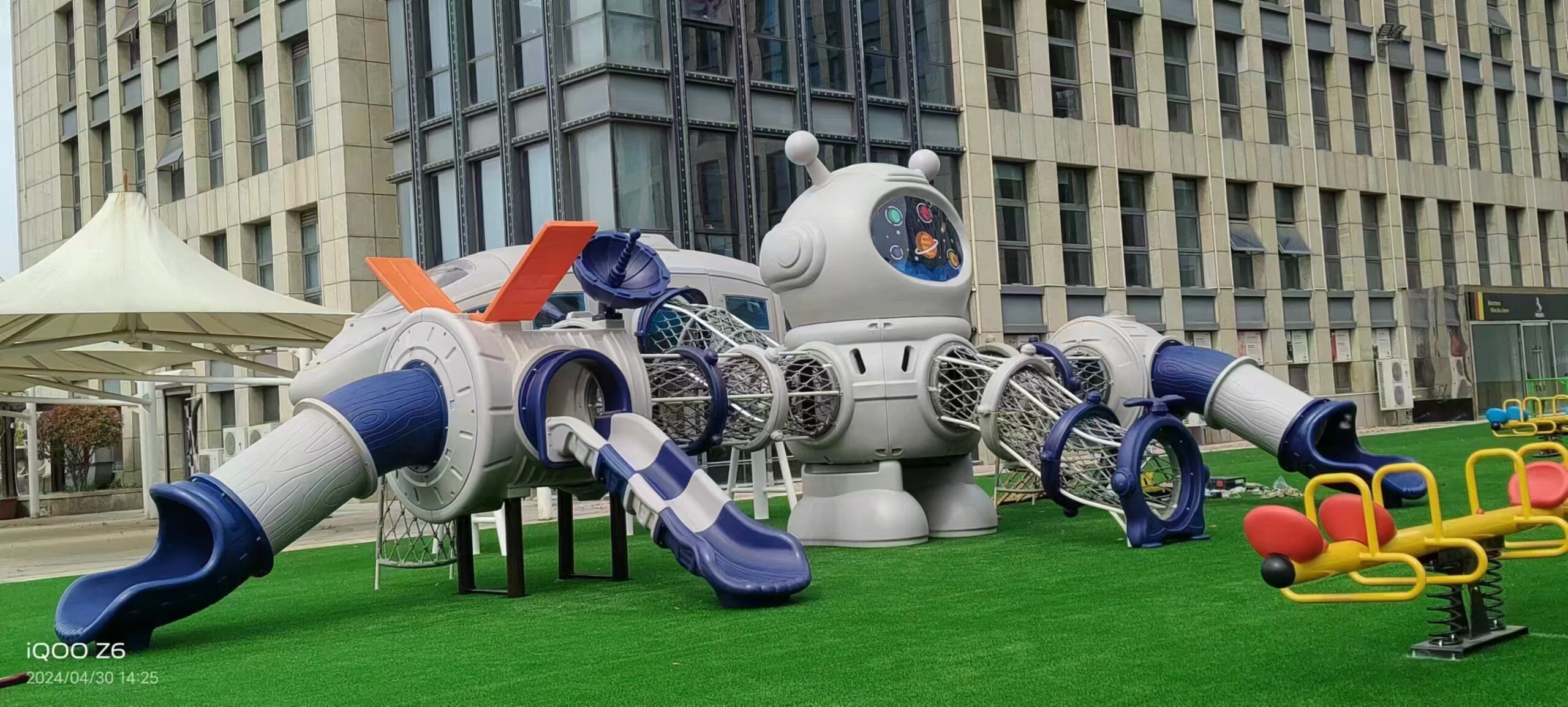
Once the project conditions are visible, products can be grouped by role. A Robot Theme Combination Playground may act as the central activity structure in a residential or public setting. A Dolphin PE Panel Spring Rider can support a smaller early-years zone. A Modular Activity Training Course creates a different kind of movement route for schools or supervised activity spaces. These are all playground products, but they do not solve the same site problem.
Project rule: decide what each product is supposed to do in the space before deciding how many products to order.
Central structures and supporting equipment should be treated differently
A large combination playground or custom climbing system usually affects circulation, visual identity and the relationship between activity zones. Smaller products such as molded spring riders, PE-panel riders or early-years balance pieces can be positioned as supporting activities around that larger structure.
For example, a community playground could use the Robot Theme Combination Playground as the main destination, then add compact rocking products or balance elements where younger users can play without needing to enter the same climbing route. A school project may instead use a timber playset together with the Modular Activity Training Course to create separate imaginative-play and movement-training areas.
This is where a supplier with a broad range becomes more useful than a supplier who only sends individual product pictures. Xinjiu’s catalog includes large combination slides, custom playground systems, timber equipment, outdoor activity courses, spring riders and early-years pieces, which allows the project team to compare several roles within the same equipment family.
How mixed product orders change playground supplier evaluation
A single-item purchase is relatively easy to compare. A mixed commercial order is more complicated because the quotation has to reflect different materials, activity types, production details and packing needs. The buyer should compare the approved equipment list rather than assume that two proposals with similar-looking images contain the same scope.
Xinjiu’s product pages show several construction directions: PE play panels, molded plastic components, timber structures, metal frameworks and rope networks. A mixed order might therefore include a timber climbing set, a PE-panel rider and a large plastic combination slide. The relevant question is not whether one material is universally better. It is whether the chosen material and structure suit the product, intended use and confirmed project specification.
PE panels, timber and molded forms solve different visual and functional jobs
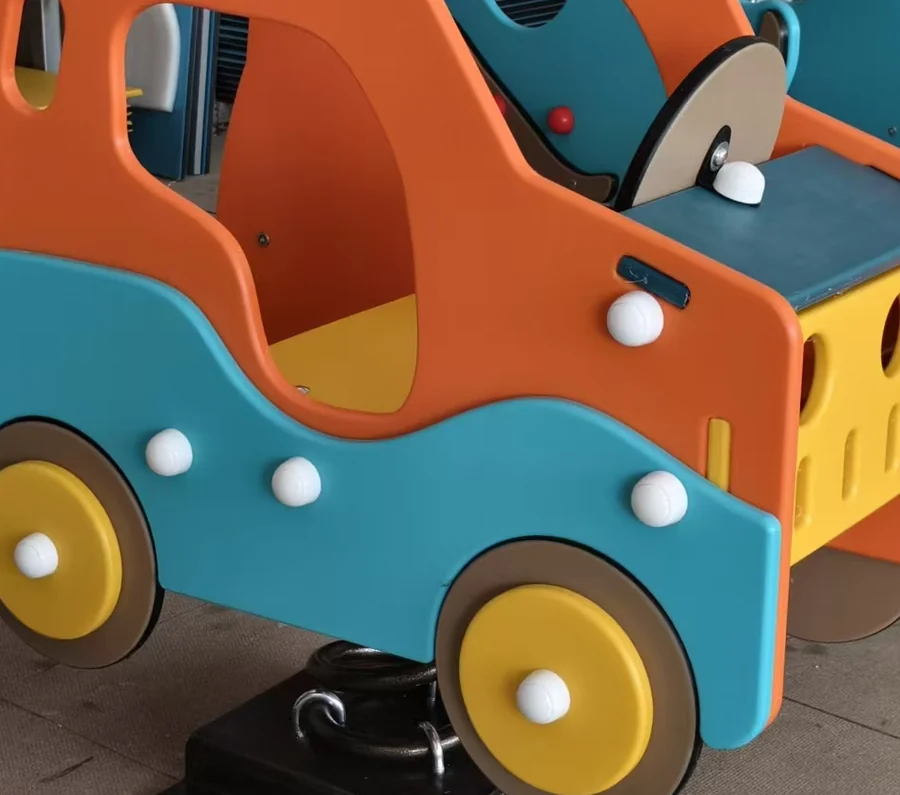
The Timber Rope Bridge Playset uses a natural-look structure with rope crossings and climbing activity, which can fit landscaped schools, parks and family destinations. The Dolphin PE Panel Spring Rider uses shaped layered panels to create a recognizable animal silhouette in a compact footprint. Molded plastic riders such as the Horse Spring Rider or Frog Spring Rider use rounded character forms for simple rocking play.
A distributor may deliberately carry more than one of these product types because customers buy for different settings. A landscape-led project may prefer timber character. A compact early-years area may value a brightly shaped spring rider. A public playground may need a larger combination system that brings several activities into one structure.
Indoor orders need their own space logic
Indoor playground equipment should not be treated as an outdoor equipment order moved under a roof. Xinjiu’s Macaron Soft Play Playground combines pastel towers, a tube crawl and a ball pool, while the Open-Plan Indoor Play Center uses multi-level towers, slides, ball pools and activity tables for a larger family venue. The supplier needs the room layout and height information because the play route is shaped inside an existing building.
A contractor fitting out a shopping-mall family venue may need the equipment arrangement to work around structural columns and fixed entrances. A distributor selling outdoor spring riders, by contrast, may be able to discuss individual products without the same level of architectural coordination. Both are supply tasks, but the information needed to quote them properly is different.
What a commercial buyer should receive before a playground order leaves the factory
When a project is exported, the equipment itself is only one part of the handover. Xinjiu’s current service pages describe export-document support, logistics coordination, installation manuals and online technical guidance. Buyers should confirm which of those items are included for their specific order and destination rather than relying on assumptions from an earlier project.
This matters because a playground can arrive as many coordinated components. The project team needs to understand how the approved equipment list relates to the packed shipment and how installation information will be delivered to the receiving team.
Final drawings and the equipment list should match the shipment scope
Before shipping, a contractor should be able to compare the final project information against what has been ordered. Xinjiu’s own buyer guidance recommends reviewing the final drawings, equipment list, model dimensions, materials, finishes, packing, delivery schedule and installation responsibilities before the project moves forward.
For a custom system, the drawing is especially important because the equipment may have been developed around a unique theme or footprint. For repeat products, the model name and confirmed specification become more important because the buyer may be ordering the same product for several destinations.
Destination requirements should be stated early, not added at dispatch
Public playgrounds, soft contained play and trampoline courts do not all sit under one universal standard. In the United States, the CPSC Public Playground Safety Handbook provides guidance for public playground planning and maintenance, while ASTM F1487 covers public-use playground equipment within its scope and specifically excludes soft contained play. In European markets, the EN 1176 series includes separate parts for general playground requirements, slides, rocking equipment, fully enclosed play equipment and spatial networks. Commercial trampoline courts have separate considerations under ASTM F2970.
The practical purchasing lesson is simple: tell the supplier the destination market and documentation requirements during the project brief. Do not wait until the equipment is packed to ask whether a specific standard or document applies. Xinjiu’s inquiry process already asks for the destination and certification needs, which gives the buyer a place to raise these requirements before the final scope is frozen.
Two buyer scenarios that need different supplier behavior
A contractor delivering one residential community playground
Imagine a contractor with a defined courtyard, a target age range and a developer who wants a recognizable themed centerpiece. The contractor may begin with the Nature Theme Combination Slide or Robot Theme Combination Playground, then add smaller riders or balance activities around the main structure. The supplier should help organize the equipment around the usable footprint, prepare the visual direction and keep the product list aligned with the approved layout.
In this scenario, 2D planning and 3D visualization are valuable because the developer may need to review the project before manufacturing. The contractor also needs the final equipment and delivery information to support site coordination.
A distributor building a mixed product range for repeat customers
A distributor may not have one fixed site. Instead, the business may sell to schools, parks, communities and indoor venues. In that case, it makes sense to separate project-led products from easier repeat items. Spring riders, early-years balance pieces and selected compact playsets can be discussed as individual products, while large combination slides, indoor soft-play layouts and custom playground systems require more project information.
This distinction can reduce confusion in repeat purchasing. It also lets the distributor ask the supplier for the right information at the right time rather than sending every inquiry through the same process.
Use the supplier’s range to narrow choices, not to enlarge the quotation
A broad range can tempt buyers to add products simply because they are available. A better approach is to ask what the project would lose if a product were removed. If the Robot Theme Combination Playground already provides climbing, bridges and several slide exits, the next product should add a different kind of play value rather than duplicate the same experience. If an indoor soft-play layout already contains slides and a ball pool, another activity should be considered in relation to circulation and age zoning rather than as an isolated attraction.
- For schools, compare activity courses, timber climbing and age-appropriate combination play.
- For residential communities, balance a central structure with compact supporting activities.
- For parks, consider whether the project needs a visual landmark, a climbing destination or a mixed family play area.
- For indoor family venues, begin with floor area, clear height and activity zones before selecting a theme.
- For distribution, separate repeatable stock-type items from site-specific project systems.
Xinjiu’s product categories are useful for building that first shortlist. The custom design and manufacturing process is the better next step when the project needs a non-standard layout, theme or equipment combination. For buyers comparing the business behind the catalog, the company and manufacturing overview explains the Wenzhou-based design, production and export-support workflow.
It is also useful to read the related playground equipment manufacturer project guide, which focuses more closely on how contractors review the manufacturing stage before production.
A good supplier relationship does not make the project bigger. It makes the project clearer: fewer assumptions, a more deliberate equipment mix, and a better-defined handover from selection to production and delivery. For a closer look at the production side, see the contractor guide to playground equipment manufacturing.