Blog
Soft Play Equipment for Family Entertainment Centers: One Connected Journey or Several Zones?

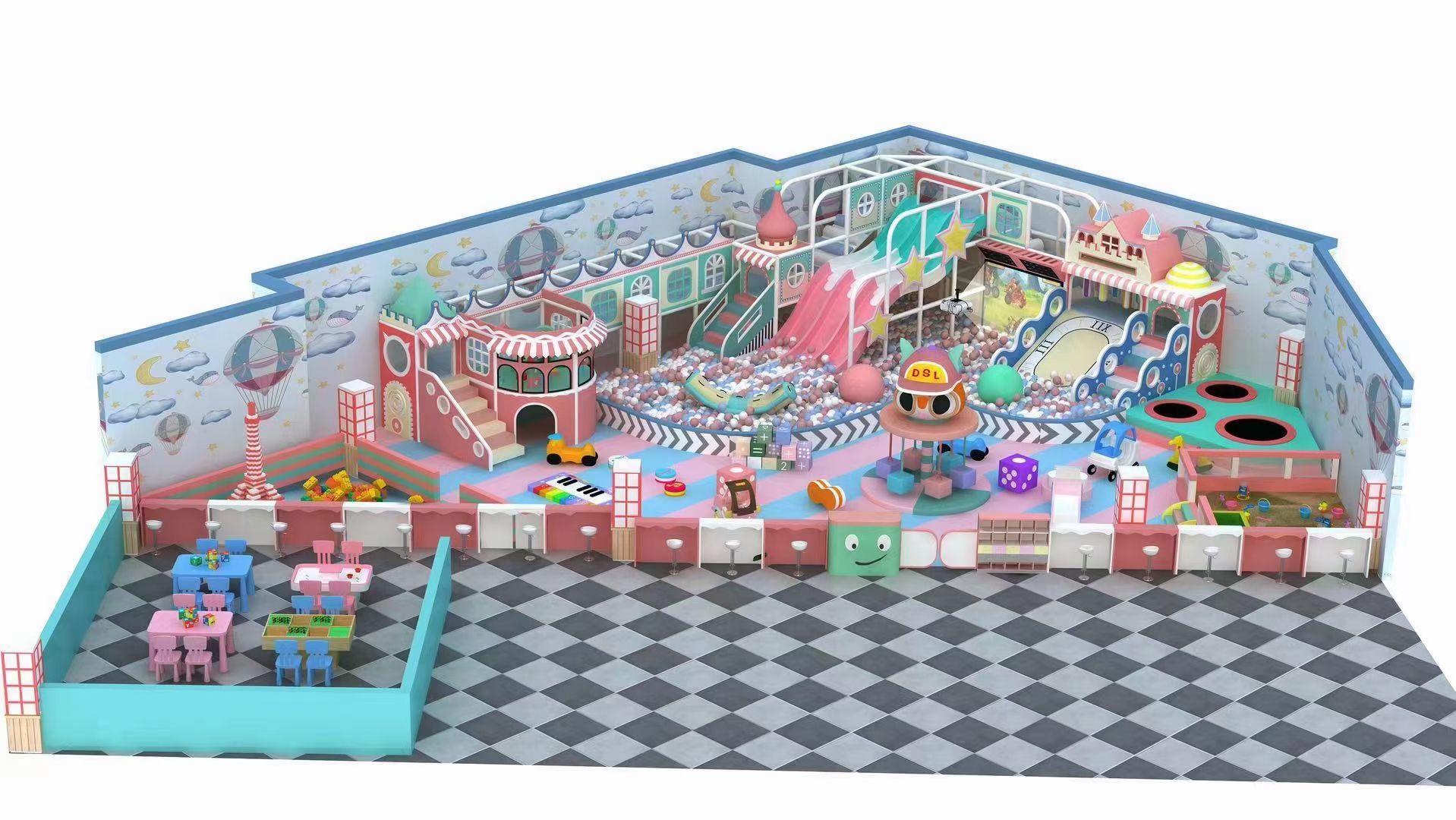
Two venues can order similar towers and still offer very different visits. In one, children return to the same connected climb-and-slide journey. In the other, families move between several activities and pause at floor-level play before choosing another zone. Buyers selecting soft play equipment for family entertainment centers should decide which visit they intend to support before adding attractions. Xinjiu’s indoor configurations include connected towers, themed systems, open-plan activity combinations and trampoline concepts. Confirm the intended users, room arrangement and operating boundaries for the selected systems before comparing the equipment offers.
Soft play equipment for family entertainment centers can center on a repeatable route
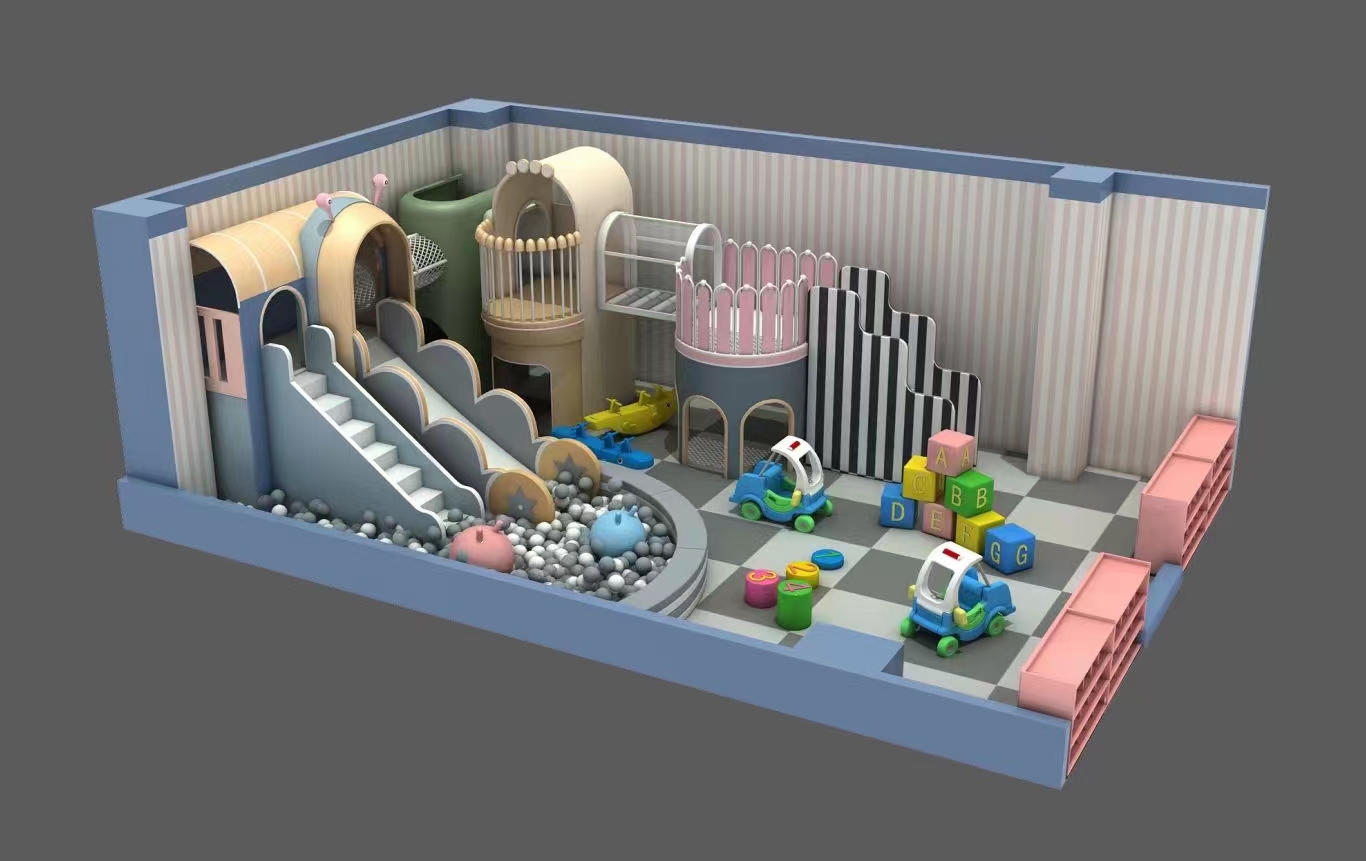
The Twin-Tower Indoor Soft Play shows a tube connection between towers, soft stairways and a slide into a ball pool. That arrangement gives a buyer a clear journey to discuss: enter, climb, cross and descend. For a neighborhood FEC focused on recurring visits, a coherent route may matter more than a large collection of unrelated activities. The configuration should make it easy to understand what children can do next. Its published picture does not establish the number of simultaneous users or a suitable age range.
Twin-Tower soft play gives repeat visits a recognizable crossing
An operator planning short recurring sessions may want the tower crossing to be the activity children recognize immediately. Review whether the intended entrance leads naturally toward the soft stairs and whether the slide return allows another round without an awkward detour. That discussion differs from choosing towers only for their height or appearance. The buyer is selecting a journey that can be explained to families, while the supplier needs to confirm the actual arrangement and model-specific operating guidance.
Consider an FEC that expects one part of the floor to remain available for adults accompanying younger children. A Twin-Tower system could be a useful starting point if its connected route leaves that floor-level relationship workable. It is less useful if the crossing or descent forces every activity through the same congested corner. Ask the supplier to compare the proposed arrangement with the floor-level activities the operator really intends. Do not infer a smaller operational footprint from the fact that the towers connect above the floor.
An open-plan FEC needs floor-level activities with a purpose
The Open-Plan Indoor Play Center combines multilevel towers, ball pools and activity tables. It suggests a broader activity offer than a single tower crossing. The useful question is how these activities relate to each other. An activity table should provide a real place to join play, not simply occupy an unused gap near a tower. The ball pools should also have identifiable access and relationships to the descending routes. Review the proposed arrangement as several linked choices within one venue.
Open-Plan activity tables should not become waiting furniture
For a destination FEC with several attractions, floor-level activities may give families an alternative to joining the tower route immediately. If those tables sit beside the entrance queue or a slide return, their intended play function can be lost. Have the proposed plan show where a child stands at a table and how another child passes toward a tower. The equipment decision should preserve the purpose of the activity. Adding tables to a congested route does not create a genuinely broader experience.
The IAAPA description of family entertainment centers includes varied entertainment formats and highlights operational design. That industry context supports treating the venue as a combination of experiences. It does not prove that every experience belongs in one undivided room. Xinjiu’s Open-Plan concept gives a concrete soft-play starting point; the operator must still choose which activities deserve distinct space and how families will move between them.
If the buyer wants one connected journey with a clear entrance and descent, the Open-Plan option may be unnecessarily broad unless its floor-level activities have a defined role. If the buyer wants several ways to participate, the Twin-Tower concept alone may not express that operating idea. Compare the two against the intended visit rather than against an activity count. Xinjiu describes indoor layout and visualization services, which can help show those relationships for the actual premises.
Castle and Vintage soft-play themes add different journeys to the FEC
The Castle Theme Soft Play Playground includes a pastel facade, double slide, enclosed climbing routes and a ball pool. The Vintage Theme Indoor Playground includes clock-front towers, connecting tunnels and varied slide routes. Both can give a venue a recognizable identity, but their activity relationships are different. A buyer comparing them should trace the climbs, crossings and returns, not merely choose between two decorative stories. The theme is useful when it helps express a play experience the venue can operate.
Castle double slides concentrate the return that operators need to understand
A Castle configuration may suit an operator who wants an identifiable centerpiece with paired descents. Review how those descents enter the ball-pool arrangement and how children return toward the enclosed climb. If the FEC also has floor-level activities nearby, keep their approach separate from the slide destination. The double slide is a structural detail that should influence the proposal. It is not evidence of a particular capacity, and the facade does not establish that the enclosed route will be visible from every adult position.
Vintage is worth comparing when the buyer wants the connection between themed towers to form a larger part of the experience. Its tunnels and slide routes can give children different transitions, but those transitions need to remain coherent in the actual room. A column or another attraction might interrupt the apparent sequence. Request the view that shows the specific tunnel route and its return, alongside the overall illustration. Do not approve the Vintage concept solely because the clock-front towers create an attractive central image.
For a venue refreshing its offer, a change from Castle to Vintage should be evaluated as a change in journey as well as theme. Ask which activities remain comparable and which movement relationships are new. Reusing the old entrance or adult viewing position may no longer make sense. This is a hypothetical operating decision, not a claim about a completed Xinjiu customer project. The supplier’s proposed configuration needs to answer it for the premises being considered.
Compare the FEC visit before comparing the soft-play quotation
The two operating approaches below help make the comparison concrete. They do not assign fixed capacities or financial results to the concepts. A connected system can be complex, and an open-plan venue can be compact; neither label settles suitability. Use the table to identify what the operator wants children and adults to do, then request the configuration that provides those relationships in the available room.
| Operating relationship | Connected-route emphasis | Several-activity emphasis |
|---|---|---|
| Joining play | Twin-Tower stairs lead into the crossing. | Open-Plan tables and tower entries need distinct approaches. |
| Returning after a slide | The ball-pool return supports another circuit. | A return may lead toward another floor-level activity. |
| Introducing a theme | Castle paired descents can define the centerpiece. | Vintage towers and tunnels need a role within the wider offer. |
A purchasing team can use the same operating description when requesting alternative proposals. If one proposal includes tables and another does not, ask whether that changes the intended visit or only the equipment scope. For a Castle offer, identify the facade, enclosed climb, paired slides and pool boundary. For Vintage, identify the towers, tunnels and selected slide routes. This avoids comparing an attractive whole-venue image with a quotation that includes only some of its depicted activities.
The trampoline and foam-pit zone is a separate equipment decision
Xinjiu’s Trampoline & Foam Pit Park concept shows jumping lanes, foam pits and padded obstacles. Those features can form part of a broader FEC offer, but they should not be treated as an extension of the soft-play ball pool. The activity, its entry and its operating requirements are different. A buyer planning both zones needs a clear boundary between the tower play route and the jumping arrangement, including how families understand which equipment they are entering.
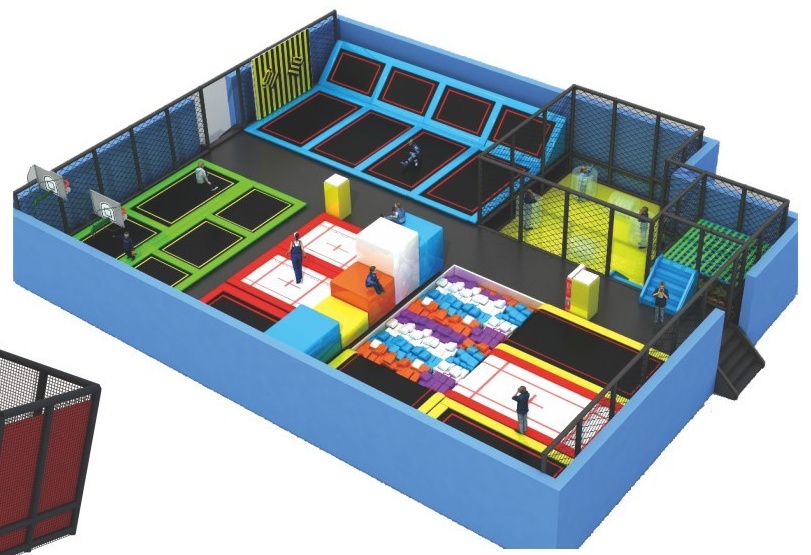
ASTM F2970 addresses commercial and institutional trampoline courts. This is a different equipment subject from soft-contained play. The reference helps buyers distinguish the technical discussions; it does not certify Xinjiu’s pictured arrangement. Request the information applicable to the actual court, pit and padded components offered. Pit depth, bed performance, user guidance and the relevant site requirements cannot be established from the concept rendering.
A destination operator might want older family members to choose the trampoline zone while other children use soft play. That idea still needs model-specific user guidance and an operating plan; a rendering cannot define who may use each activity. Show the separate entrances and the relationship to the common family area in the proposal. The existing trampoline equipment supply discussion is a useful companion when evaluating that separate package, alongside the selected soft-play system.
Keep the chosen FEC activities workable when one component is unavailable
Think about a Castle slide being temporarily closed for inspection, or an Open-Plan activity table needing attention. The operator should understand which part of the experience remains usable under the applicable operating instructions. In a connected route, one unavailable crossing can affect the onward journey; in a broader arrangement, the adjacent activity may have a separate approach. Confirm the supplied system’s instructions and avoid inventing a closure procedure from the picture.
The component information should also follow the chosen venue zones during delivery and installation. Identify which packed items belong to the Twin-Tower crossing, Castle descent, Vintage tunnel or trampoline package. Request packing and assembly information for those actual components rather than a general assurance that the whole FEC will be easy to install. Xinjiu describes installation manuals, remote guidance and project coordination capabilities; agree how those services apply to the separate arrangements in this order.
During the equipment review, compare the Open-Plan activity-table positions and the Castle slide destinations with the approved venue arrangement. A delivered table that needs a different approach can change the relationship between activities even if the tower remains unchanged. For the trampoline package, keep its padded obstacles and pit components identified separately from soft-play pieces. If a component differs from the agreed description, ask the supplier to explain the effect on that zone before installation. A visually coordinated FEC still contains equipment with different functions, and the receiving team should not treat all padded items as interchangeable.
When the operator says, “We want more things to do,” ask which missing part of the visit should improve. If it is a clear repeatable route, develop the tower journey. If it is an alternative way to join play, protect the floor-level activity space. If it is a jumping attraction, define a separate equipment and operating zone. The selected FEC offer should answer that specific need before another item is added to the list.