Blog
Wooden Playground Equipment Manufacturer: Where Timber Play Systems Fit Best

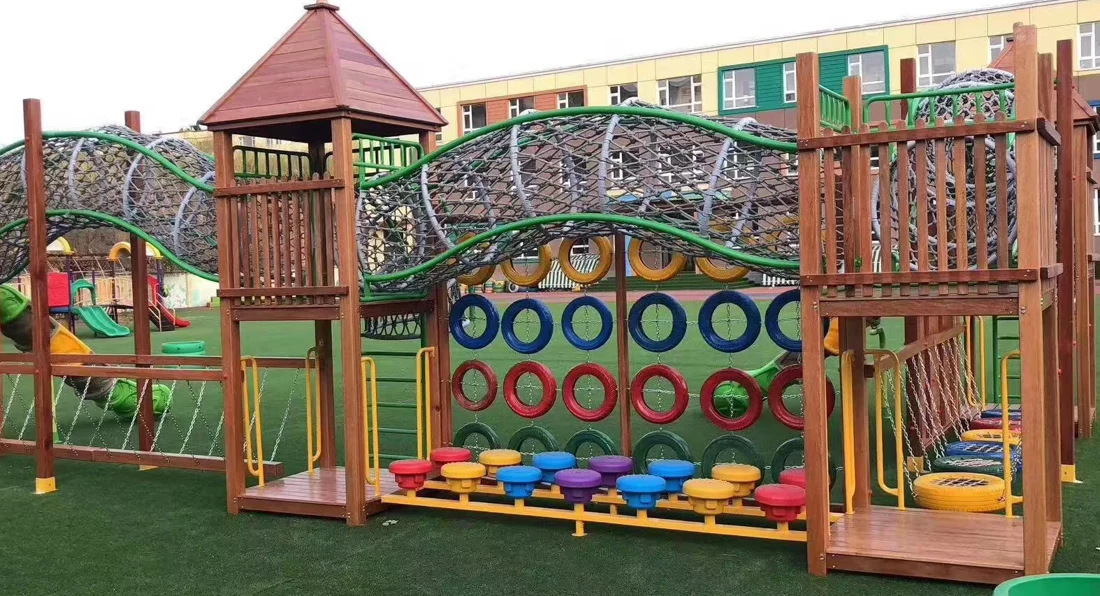
Wooden playground equipment works best when the buyer wants the play structure to feel connected to the landscape as well as to the activity plan. Timber can give a school, park, community or family destination a warmer visual character, but it should not be selected only because it looks natural. The structure still has to fit the site, provide the right challenge level and work with the rope, climbing and slide elements that form the final play route.
Xinjiu’s current wooden playground range includes the Timber Rope Bridge Playset, Timber Climbing and Net Course and Twin-Tower Timber Slide Set. The wider outdoor range also includes rope-climbing systems, combination slides, spring riders and custom playgrounds, allowing buyers to compare timber-led routes with more graphic PE-panel, molded-plastic or metal-framed alternatives. Xinjiu also supports 2D layouts, 3D visualization, OEM/ODM, export coordination and installation guidance for project work.
A wooden playground equipment manufacturer should explain what timber changes in the project
Timber affects more than appearance. It changes the visual weight of the playground, the way rope elements are integrated and the relationship between the equipment and a landscaped environment. A manufacturer should help the buyer understand whether those qualities support the project rather than presenting wood as universally superior.
Timber works well where the playground should sit quietly in a landscape
The Timber Rope Bridge Playset uses timber-led towers and rope crossings to create a warmer, grounded character. The Twin-Tower Timber Slide Set extends that approach with two connected towers and slide exits. These products can suit schools, parks and residential landscapes where the playground should feel integrated rather than highly graphic or sculptural.
Timber may be the wrong starting point for a deliberately futuristic or highly themed site
A property development asking for a robot, space or large sculptural landmark may be better served by a different product family. The Robot Theme Combination Playground, Bird’s Nest Custom Playground or Architectural Spiral Slide System can provide stronger geometric or graphic identity. A wooden playground manufacturer should be willing to say when timber does not fit the brief.
Wooden playgrounds are often strongest when rope and climbing define the route
Timber gives the structure its visual character, but much of the play value can come from rope crossings, climbing walls, nets and elevated transitions. The buyer should therefore evaluate the timber and rope system together rather than treating the wooden posts as the product and the climbing elements as accessories.
The Timber Rope Bridge Playset suits a shorter mixed route
This playset combines rope crossings, activity panels and a compact slide. It can create a varied route without requiring the scale of a large destination structure. A school or community buyer may use it as the main play piece where the footprint is limited but still needs climbing, crossing and sliding.
The Timber Climbing and Net Course suits projects that want a longer challenge sequence
The Timber Climbing and Net Course combines climbing walls, net tunnels and elevated bridge movement. It can serve a more linear site or a project where the climbing journey is the primary activity. It is not simply a larger version of the Rope Bridge Playset; the route and challenge are different.
The Twin-Tower Timber Slide Set adds a clearer tower-and-slide destination
Two connected towers extend the play journey and give the structure a stronger central identity. This can fit a school or park that wants a recognizable playset while retaining the warmer timber character. The buyer should compare the tower footprint, connection route and slide exits with the site plan before confirmation.
Wooden playground equipment should be planned around the site before finish choices are discussed
Buyers sometimes begin with questions about color or finish because those details are visible. The more important early decision is whether the timber route fits the usable site. A long climbing course, a two-tower slide set and a compact rope bridge system need different footprints and circulation around them.
A school edge or narrow landscaped strip may suit a linear timber route
If the available area is long and narrow, the Timber Climbing and Net Course can make more sense than a broad central combination structure. The project can sequence climbing and crossings along the site rather than force the equipment into a geometry the location does not support.
A more open community or park site can support a twin-tower layout
A larger open area gives the Twin-Tower Timber Slide Set room to become the central structure. Smaller products such as spring riders or balance activities can then support younger users in a separate zone rather than being inserted into the timber route itself.
A wooden playground manufacturer should make material choices specific to the final system
Xinjiu’s site states that material and finish selections can include anti-UV, anti-corrosion and eco-conscious options according to equipment type, project environment and confirmed specification. Buyers should therefore ask what is confirmed for the actual timber system rather than assuming one general finish applies across wood, rope, metal connections and any other components.
Timber, rope and connection hardware should be reviewed as one coordinated structure
A timber playset is not only timber. Rope crossings and nets are part of the activity route, and metal connections may be part of the structural system. A project review should keep these elements connected to the final design rather than discussing them in isolation.
Visual finish should follow the project character
A school may want a brighter direction, while a landscaped park may prefer more restrained natural tones. The manufacturer can support visual coordination, but the buyer should avoid letting finish decisions replace the more important questions of route, challenge and site fit.
Wooden playground equipment should be compared with other outdoor product families
A buyer deciding between timber and another route should compare the experience and site character rather than ask which material is “better.”
| Product direction | What it emphasizes | Where it may fit best |
|---|---|---|
| Timber Rope Bridge / Timber Climbing | Warm landscape character, rope crossings and climbing | Schools, parks, residential landscapes and family destinations |
| PE-panel combination play | Graphic color, shaped panels and multiple activities | Communities, schools and colorful public play areas |
| Net-climbing systems | Open climbing challenge and visible rope geometry | Adventure zones and larger parks |
| Custom landmark systems | Distinctive sculptural identity | Destination projects, major public spaces and branded developments |
Timber can be the right answer when the project benefits from a quieter visual presence and climbing-led activity. It may be less appropriate where the client specifically wants a large sculptural icon or a brightly themed landmark.
Wooden playground orders should keep the final route visible through production
If the buyer changes a rope crossing, bridge connection or slide position, the layout and equipment scope should be updated together. A timber project can still suffer from the same version-control problems as any custom or combination playground. The manufacturer should work from the latest approved arrangement.
Contractors should check the project handover, not only the finished appearance
A local installation team may need manuals and remote guidance for the supplied structure. Xinjiu’s service pages describe installation manuals and online technical support. The buyer should confirm what applies to the selected timber system and make sure the receiving team has the same project version that was approved for production.
Distributors should separate repeatable timber references from site-specific configurations
A distributor may use the Twin-Tower Timber Slide Set as a sales reference for several customers, but each site should still be checked. Reusing a successful image is useful; reusing a configuration without checking the new footprint is not.
When should a buyer choose wooden playground equipment?
- Choose timber when the project benefits from a warmer, landscape-friendly visual character.
- Choose a rope-bridge route when crossing and climbing are important parts of the play experience.
- Choose a longer timber climbing course when the site can support a progressive linear challenge.
- Choose a twin-tower timber set when the project needs a stronger central play structure with slides.
- Consider another product family when the brief calls for a futuristic, highly graphic or sculptural landmark.
Buyers can compare the Xinjiu wooden playground series, review the outdoor play equipment selection guide, and use the company manufacturing overview for project support information. A wooden playground equipment manufacturer should help the buyer determine when timber improves both the site character and the activity route—not simply sell wood as an aesthetic preference.
How should buyers compare two timber playground layouts?
Compare the route before the finish. One timber concept may concentrate activity between two towers, while another may stretch climbing and net challenges along a longer line. The buyer should trace where children climb, cross, pause and slide, then decide which sequence fits the site. A darker or lighter timber look can be adjusted later; a route that is wrong for the footprint is a more fundamental problem.
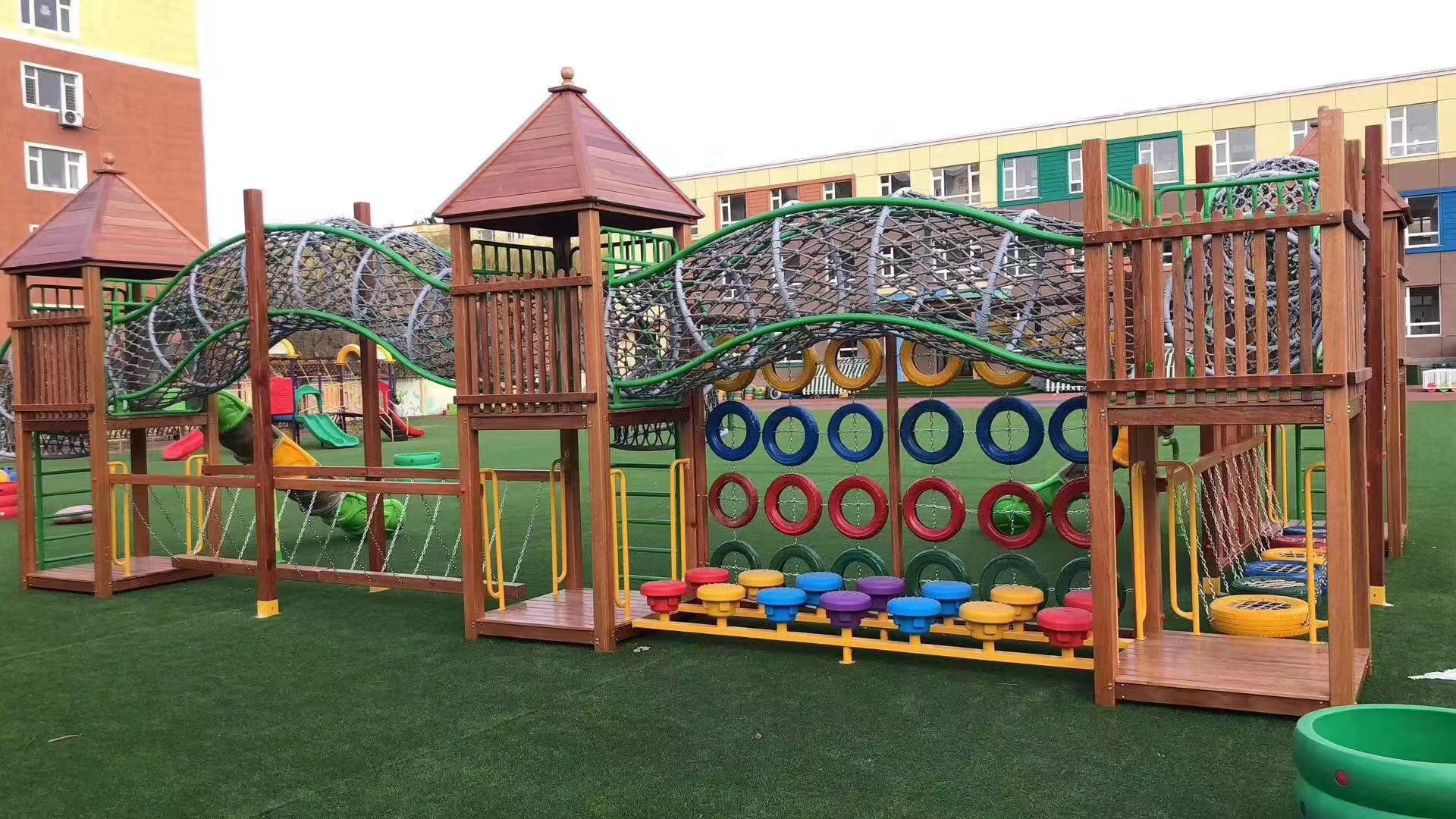
A twin-tower timber set should be evaluated as a centerpiece, not just a slide product
The Twin-Tower Timber Slide Set connects two elevated structures and extends the route through climbing, enclosed passages and slide exits. A buyer should check the space around both towers and the return areas from the slides. In a small site, the more compact Rope Bridge Playset may be easier to integrate; in a larger school or park, the twin-tower layout can justify the additional footprint.
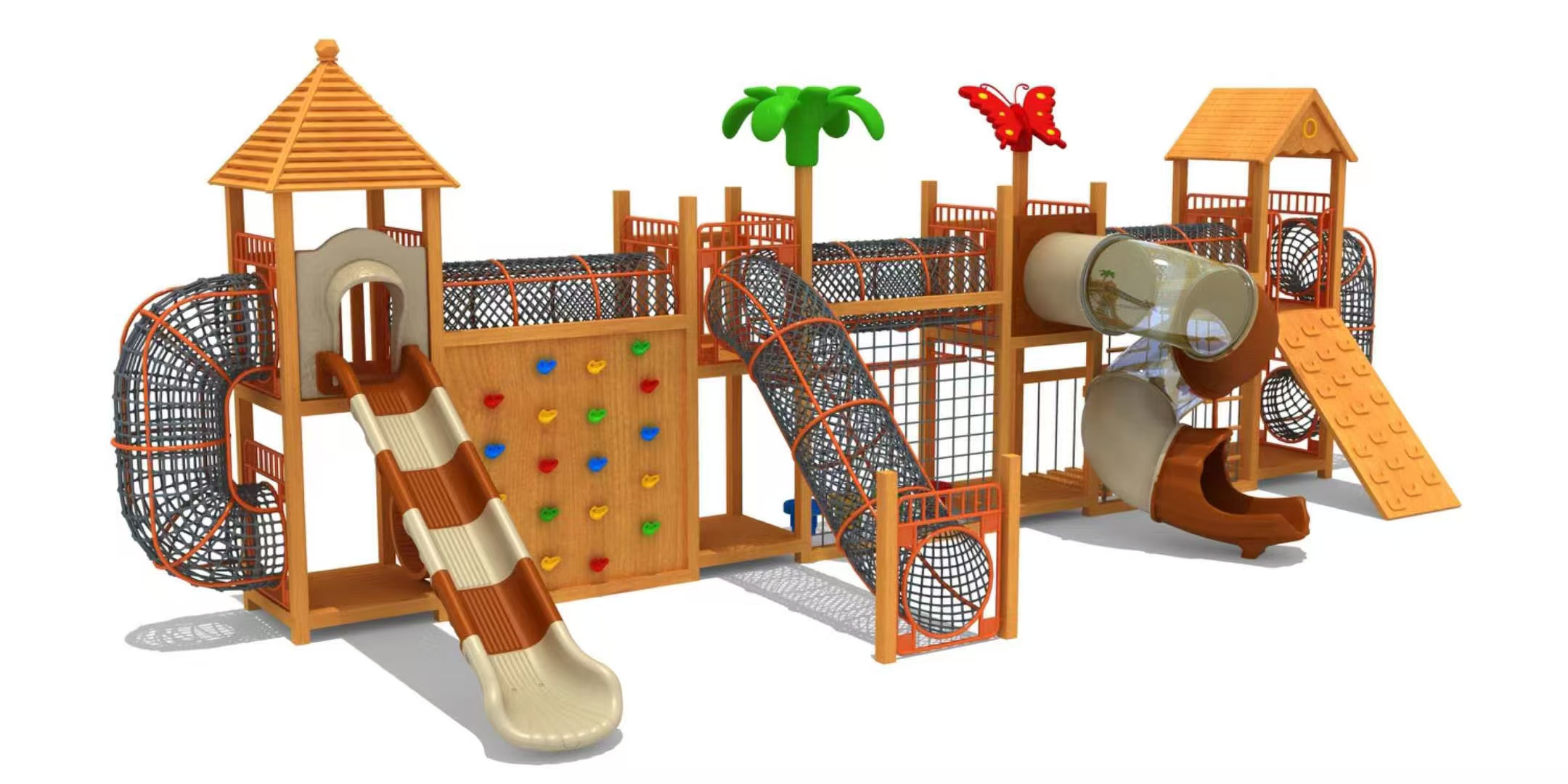
Do not assume a natural appearance means a low-complexity project
Timber playgrounds can still include elevated bridges, nets, walls and multiple slide routes. The project should use the same discipline as other commercial playground systems: confirm the layout, product scope, materials, destination needs and installation handover. The visual language may be natural, but the project information still needs to be precise.
For procurement teams, this creates a useful distinction: choose timber because the material character and climbing route fit the landscape, not because the structure is assumed to be simpler than a themed or metal-framed playground.
For a final timber review, trace the complete route from ground access through the main crossing and back to the slide or exit. If the route still makes sense without relying on the rendering’s visual atmosphere, the wooden system is solving a real play problem rather than only providing a natural-looking facade.