Blog
Commercial Playground Equipment Supplier: Project Guide

A commercial playground equipment supplier is easiest to evaluate when several people have to approve the same project. A developer may care about visual identity, a contractor may care about site coordination, a school or park operator may care about the user mix, and a distributor may care about repeatable product information. If the supplier sends each person a different version of the project, small misunderstandings can become expensive changes later.
Xinjiu supplies commercial playground equipment from Wenzhou, with product families that include custom playground systems, combination slides, timber structures, rope and net climbing equipment, outdoor activity courses, spring riders and indoor soft play. Its project support includes 2D layouts, 3D visualization, OEM/ODM development, manufacturing, export-document coordination, logistics support, installation manuals and online technical guidance. For buyers comparing options, the playground equipment categories provide the product starting point, while the custom playground workflow is more appropriate when the site or theme cannot be handled with a straightforward catalog selection.
A commercial playground equipment supplier should keep one project brief visible to every stakeholder
Commercial projects rarely move from buyer to factory in a straight line. The project may pass through an owner, landscape designer, purchasing team, contractor and installation crew. A useful supplier should therefore keep the basic project facts stable: site dimensions, intended users, preferred equipment direction, destination, quantity, customization needs and target schedule.
This is also consistent with broader playground planning practice. Commercial suppliers in the industry commonly organize work around planning, design documentation and site-specific coordination rather than treating every project as a product-only transaction. The reason is simple: playground equipment has to fit a larger space, and the larger space usually has more decision-makers than the manufacturer alone.
For a park department or property-management buyer, that shared brief also helps prevent late-stage scope drift. If the owner adds a climbing zone after the contractor has already coordinated access and surfacing, the supplier should flag the change as a project revision rather than quietly inserting another product. The same applies when a distributor substitutes one model for another: the layout and receiving information should be checked again before the order is treated as final.
When the developer and contractor want different things from the same playground
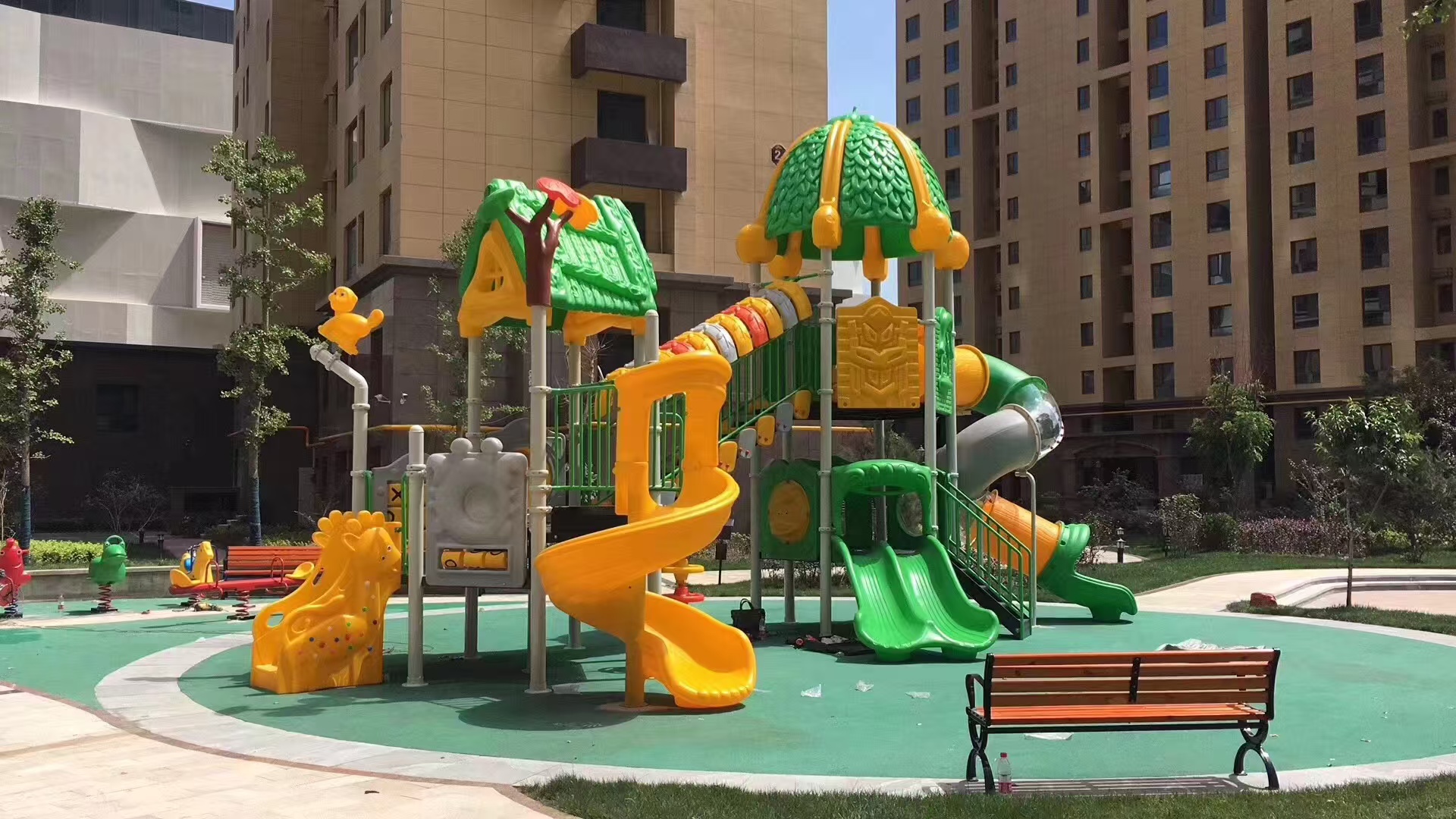
Consider a residential project. The developer may want a distinctive centerpiece that improves the visual identity of the landscape. The contractor may want a configuration that can be clearly documented and installed inside the confirmed footprint. A Nature Theme Combination Slide can answer both needs if the design remains connected to the site plan: the leaf-style roofs and coordinated colors support the landscape direction, while the connected towers and slide routes give the contractor a defined equipment scope.
If the developer later asks for a larger climbing feature, the supplier should not simply add another structure to the quotation. The updated proposal should show whether a Circular Net Climbing System or Spider Web Climbing Course can fit without creating a conflicting activity zone or blocking circulation. That is a project decision, not a catalog decision.
When a distributor needs repeatable products and project-led systems in the same range
A distributor may want products that can be reordered quickly and other products that can support higher-value projects. Xinjiu’s molded Horse, Frog and Airplane Spring Riders and its PE-panel Deer, Car and Dolphin riders are examples of compact products with clear individual identities. They can be presented as separate items more easily than a custom playground system.
By contrast, the Bird’s Nest Custom Playground, Architectural Spiral Slide System and large combination structures are strongly linked to the site. They should be sold with a project conversation about dimensions, users, visual direction and installation context. A supplier who separates those two sales routes helps the distributor avoid turning every inquiry into the same process.
Commercial playground suppliers should make product roles easy to compare
For a mixed order, the buyer should be able to explain why each product is present. A large combination structure may serve as the central play route. A timber course may add a different movement experience. A spring rider may support younger children. An obstacle course may serve a supervised school or community activity zone.
That distinction matters because products can compete for the same space even when they look different. The CPSC Public Playground Safety Handbook, for example, identifies age separation and conflicting activities as layout considerations. A supplier should therefore avoid presenting every item as equally suitable for every position in the site.
Choose a central structure before adding secondary products
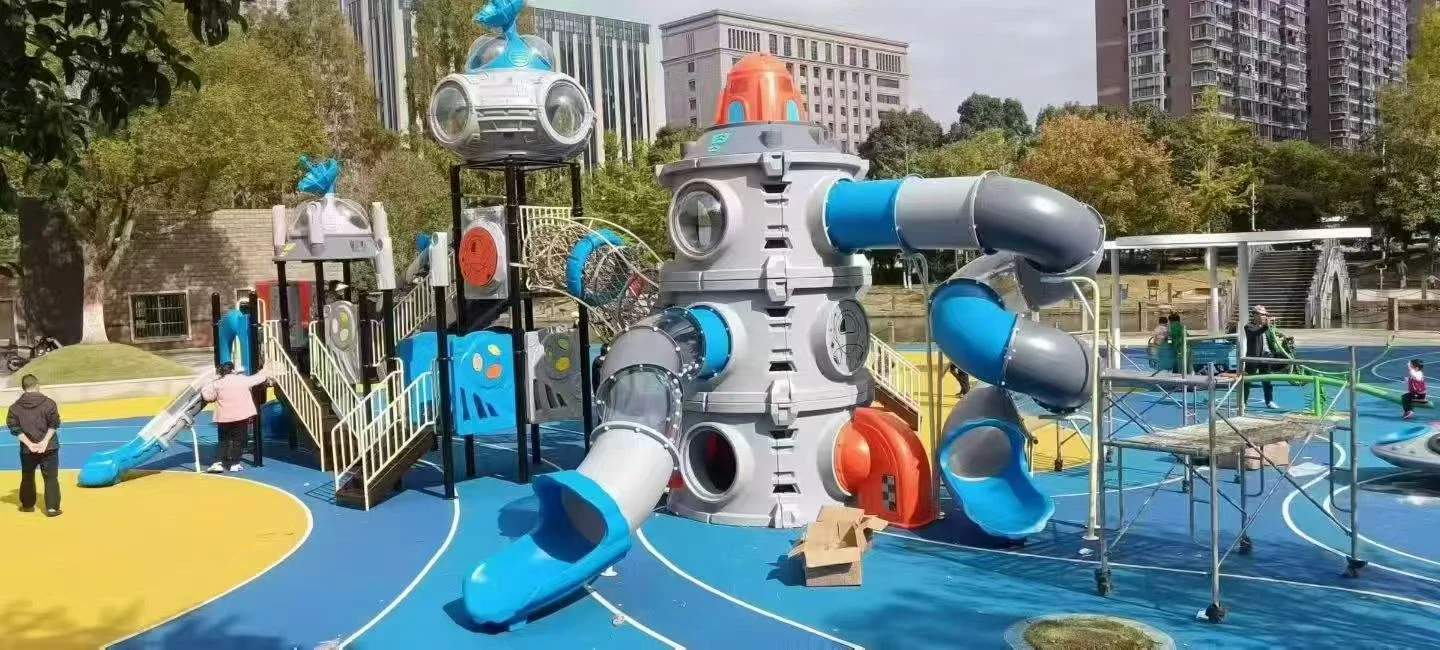
The Robot Theme Combination Playground brings together towers, nets and several slide exits. The Castle Theme Combination Slide creates another multi-activity route through connected towers and climbing panels. When either becomes the center of a commercial playground, the remaining products should fill genuine gaps.
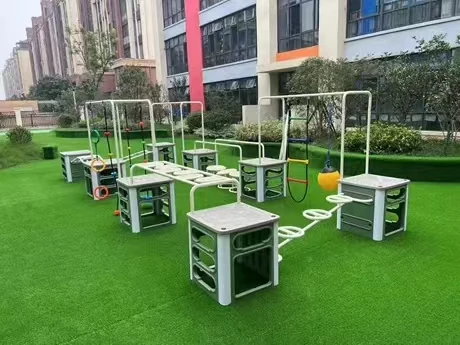
A smaller PE-panel rider can add simple movement for a younger zone. A Modular Activity Training Course can create a separate balance and coordination route. A timber playset can introduce a different material character. The supplier’s value is not in suggesting all three automatically, but in helping the buyer decide which one actually improves the project.
Commercial indoor and outdoor orders should not be merged into one specification logic
Xinjiu also supplies indoor soft play, including Macaron Soft Play, Clock Theme Soft Play, Twin-Tower Indoor Soft Play and larger open-plan family play layouts. These products are planned around building conditions such as floor area, clear ceiling height, columns and entrances. Outdoor projects are shaped by different site and environmental conditions.
A distributor carrying both ranges should therefore keep them commercially distinct. Indoor customers need room dimensions and internal circulation information earlier. Outdoor customers may need site plans, landscape relationships and destination-market requirements. The same supplier can support both categories, but the project questions should not be identical.
The commercial quotation should be readable as a project document
A quotation becomes difficult to compare when it contains only product pictures, quantities and one total price. Commercial buyers need enough information to understand what has changed between versions and what the final order actually includes.
Xinjiu’s own guidance recommends reviewing final drawings, equipment lists, model dimensions, materials, finishes, packing, delivery schedule and installation responsibilities before a project moves forward. Those points are useful because they connect the commercial document with the production and delivery stages.
A school tender and a private property project may need different evidence
A school or public project may involve formal internal approval and destination-specific requirements. A private property project may move faster but still require drawings and visual approval from the owner. In both cases, the supplier should know what information the buyer needs before production.
For a school project using a Modular Activity Training Course and Timber Rope Bridge Playset, the buyer may focus on intended age groups, activity sequence and the relationship between zones. For a property project using a custom landmark, the owner may focus more on 3D visualization and visual identity before the technical scope is frozen.
Destination and documentation questions belong before dispatch
International commercial orders need an early conversation about destination requirements. ASTM F1487 covers public-use playground equipment within its scope and addresses subjects such as materials, performance, access, layout, installation and maintenance; soft contained play is outside that scope. Buyers who source both outdoor equipment and indoor soft play should therefore avoid assuming that one standard applies identically to both categories.
Xinjiu asks buyers for the destination and certification needs during the project brief. Its service pages also describe export documents, logistics coordination, installation manuals and remote technical guidance. The buyer should confirm exactly which documents and support apply to the selected products and market.
How three commercial buyers can use the same supplier differently
| Buyer | What they need first | Useful Xinjiu starting points |
|---|---|---|
| Playground contractor | Site dimensions, equipment scope, latest drawings and delivery responsibility | Combination slides, custom systems, timber play and climbing |
| Property developer | Visual direction, project theme, user group and relationship to the landscape | Nature Theme, Robot Theme, Bird’s Nest and other custom structures |
| Distributor / wholesaler | Clear split between repeat products and site-specific project systems | Spring riders and early-years pieces for repeat sales; larger systems for project development |
This is why supplier evaluation should not produce one universal scorecard. A contractor may value layout coordination most. A developer may value custom visualization. A distributor may value range clarity and repeatability. The best supplier relationship is the one where the project information matches the buyer’s actual role.
Commercial playground supply is strongest when changes remain traceable
Commercial projects change. A site measurement can be updated. An owner can remove one structure. A school can change the intended age group. A distributor can replace one product family with another. The important question is whether those changes are reflected consistently in the drawings, equipment list and production scope.
A practical way to control this is to treat the latest approved layout as the visual reference and the latest confirmed equipment list as the commercial reference. When those two documents disagree, the order should not move forward until the difference is resolved.
- If a combination structure changes, confirm the updated tower, slide and climbing configuration.
- If a timber system changes, confirm which bridge, net or climbing elements remain in the order.
- If spring riders are substituted, confirm the exact character type and construction route selected.
- If a custom theme changes, confirm whether the change is visual only or affects the structure and activity path.
- If the destination changes, review the documentation requirements again before shipment preparation.
Xinjiu’s company profile describes a manufacturer established in 1999 with project support spanning planning, design, manufacturing and export coordination. That background is most valuable when the supplier uses it to keep the commercial project coherent rather than simply to add another claim to a sales page.
Build the order around decisions the buyer can verify
A commercial buyer can verify whether the site dimensions were used, whether the final layout matches the order, whether the selected products have distinct roles, whether material choices are attached to actual products and whether the delivery responsibilities are understood. Those are stronger purchasing signals than broad claims about service or quality.
For a first shortlist, review the commercial playground equipment families and identify one central structure plus only the supporting products that add a different type of play. If the site requires a non-standard form or a strong project identity, move into custom development before the commercial scope is finalized.
A commercial playground equipment supplier should make a complex order easier for every person who touches it. When the developer, contractor, distributor and receiving team can all understand the same site, the same product list and the same handover, the supplier is doing more than moving equipment—it is reducing uncertainty around the project. For the manufacturing perspective, compare the commercial playground manufacturer planning guide.