Blog
Outdoor Playground Equipment Manufacturer: Project Guide

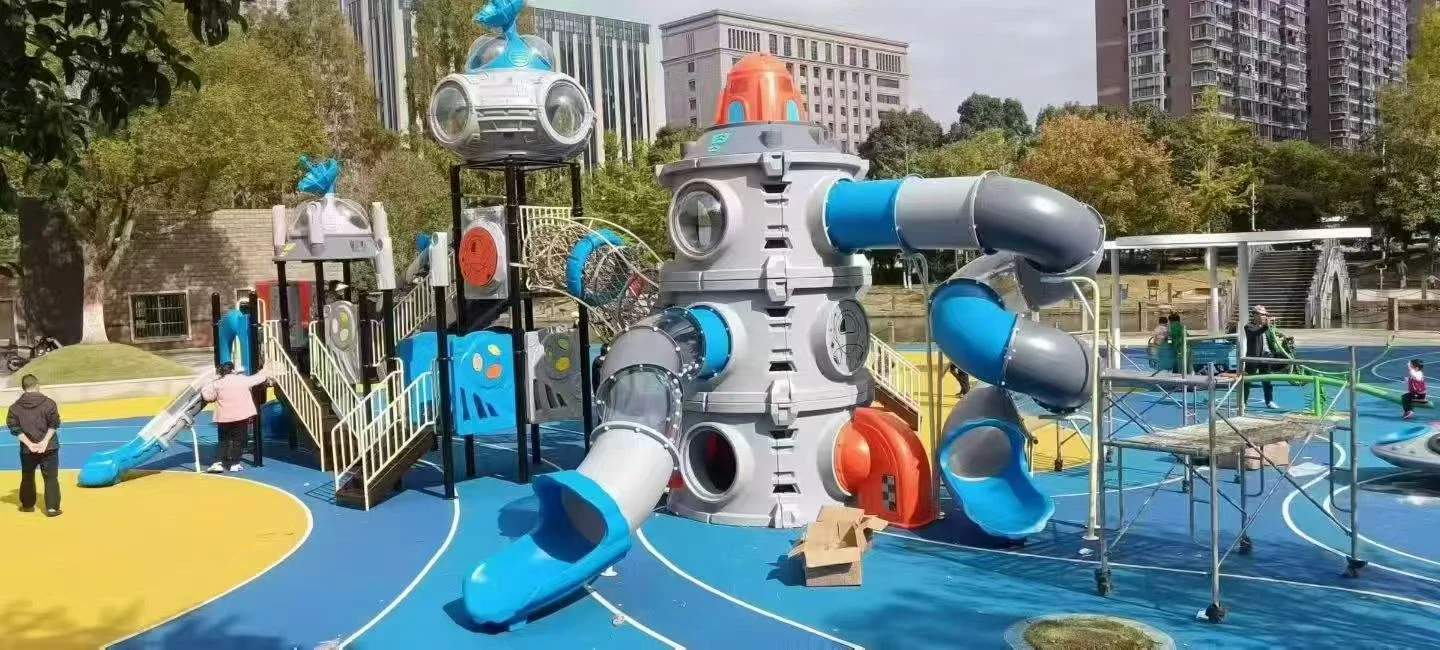
An outdoor playground project becomes easier to control when the manufacturer begins with the site rather than a catalog page. For contractors, developers, schools, landscape teams and distributors, the first questions should be practical: how much usable space is available, which age groups will use it, what activities should anchor the layout, which destination requirements apply, and who will handle installation. Xinjiu supports this process with custom outdoor playground design and manufacturing, including 2D planning, 3D visualization, non-standard development, factory production and export coordination.
A buyer can start with the playground equipment categories to compare custom systems, combination slides, timber structures, climbing equipment, activity courses and spring riders. The useful decision is not simply which product looks attractive. It is which combination fits the site, the users and the project handover.
Outdoor playground equipment manufacturing starts with the usable site
Public and commercial playground planning has to consider more than the footprint of one structure. The current CPSC Public Playground Safety Handbook highlights factors such as accessibility, age separation, conflicting activities, sight lines and supervision when a playground is laid out. Those ideas are useful for procurement even outside the United States because they remind the buyer that equipment selection and site planning are connected decisions.
Xinjiu’s own project workflow reflects that same practical sequence. Site dimensions, age groups, preferred theme, project type and destination market are collected before the equipment package is finalized. A 2D layout can organize zones and circulation, while a 3D rendering can help contractors, owners and designers review the visual direction before production.
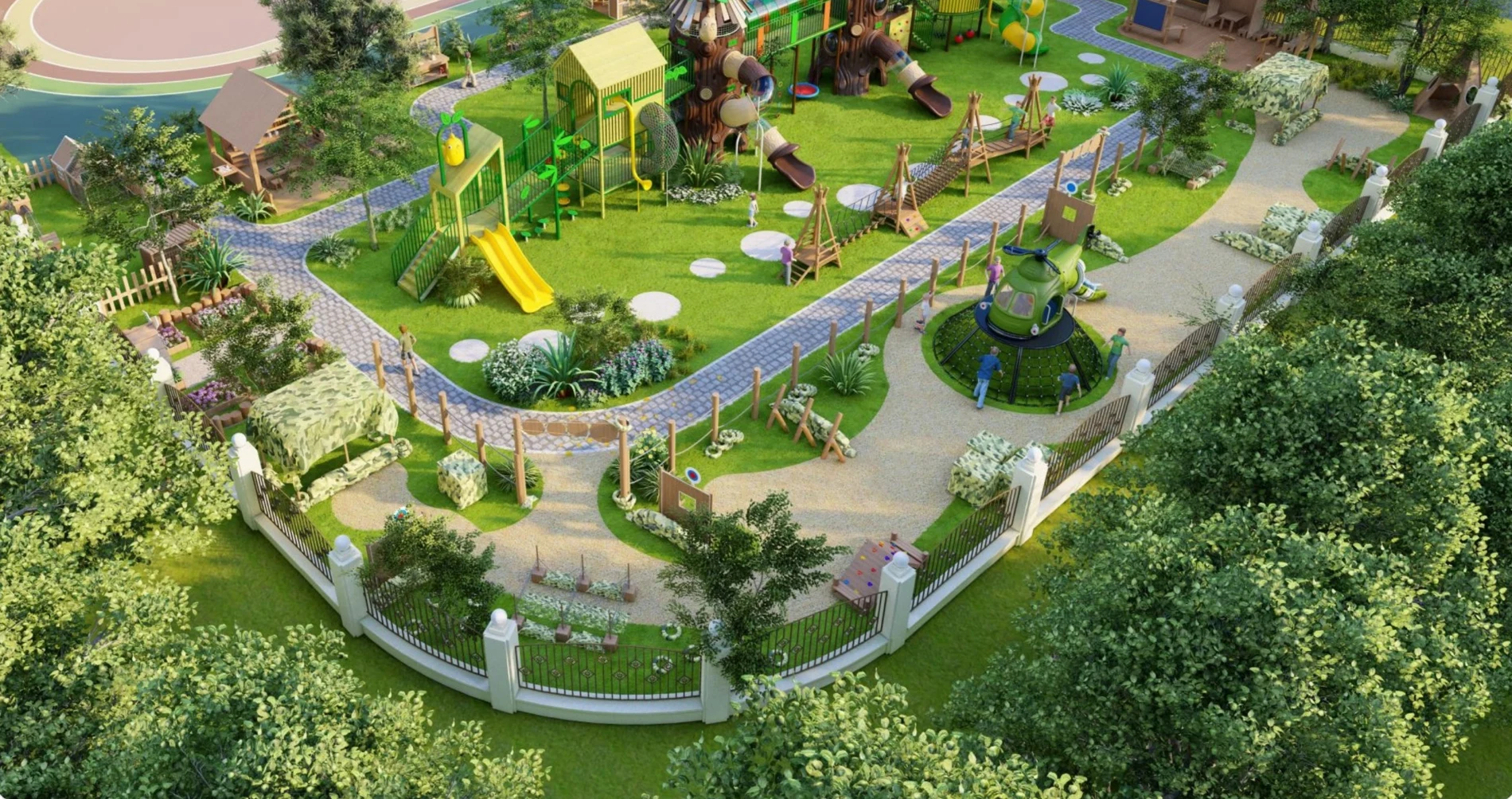
A residential courtyard needs a different equipment rhythm from a destination park
Consider a contractor working inside a residential courtyard. The project may need one clear central play structure, open circulation around the perimeter and a few smaller activities for younger users. A Robot Theme Combination Playground or Nature Theme Combination Slide can provide towers, connected routes, climbing elements and multiple slide exits in one organized footprint. Smaller riders or balance pieces can then support the main structure without turning the site into a crowded collection of unrelated products.
A destination park works differently. The project may need a visual landmark that can be seen from a distance and a longer route that encourages movement between zones. Xinjiu’s Bird’s Nest Custom Playground uses sculptural nest-shaped towers, elevated bridges and enclosed slides, while the Nature Theme Custom Playground uses leaf-roof towers, themed climbing features and linked walkways. These systems make more sense when their scale and circulation are reviewed as part of the whole landscape.
Age groups should change both the activity level and the product family
A compact spring rider and a large rope-climbing system are both playground products, but they serve different users and different moments in the play experience. Xinjiu’s range includes molded spring riders, PE-panel spring riders, early-years balance equipment, timber climbing courses and three-dimensional net systems. A project team should not choose them by visual style alone.
For younger play zones, products such as the Dolphin PE Panel Spring Rider or molded character riders create simple movement in a compact area. A Circular Net Climbing System or Spider Web Climbing Course creates a more demanding climbing route and requires a very different discussion about placement, surrounding activities and intended users. The manufacturer should help the buyer keep these roles clear during layout development.
What an outdoor playground equipment manufacturer should make visible before approval
For B2B buyers, a quotation is only useful when the scope behind it can be understood. A professional review should connect drawings, equipment names, quantities, material direction, colors, destination needs and delivery responsibilities. Without that connection, two quotations can look similar while describing very different projects.
Xinjiu describes a coordinated process that covers custom development, production, export preparation and project support. The company has operated since 1999 in Wenzhou and combines playground design with manufacturing. Its current service information includes 2D layouts, 3D visualization, OEM/ODM support, export-document coordination, logistics assistance, installation manuals and online technical guidance.
Custom structures need drawings that match the actual order
A custom structure is not simply a catalog product with a different color. The final configuration may change the relationship between towers, bridges, slides, climbing routes and access points. That is why the approved drawing and the approved equipment list should be reviewed together.
For example, the Linear Custom Play Circuit organizes bridges, panels and slides along a long activity route. The Architectural Spiral Slide System uses tall enclosed slides and geometric frames as a stronger landmark element. If either system is adapted to a site, the final dimensions and configuration should be confirmed for that project instead of inferred from an image.
A landscape architect preparing a public park may care about how the structure sits within planting and pedestrian movement. A distributor supplying a contractor may care more about whether the confirmed configuration can be described consistently across drawings, order documents and shipping information. The same custom product therefore creates different information needs for different buyers.
Material choices should be tied to the selected outdoor product
Xinjiu’s current range uses several material families: PE play panels, molded plastic elements, timber structures, metal frameworks and rope networks. No single material route is presented as the answer for every playground.
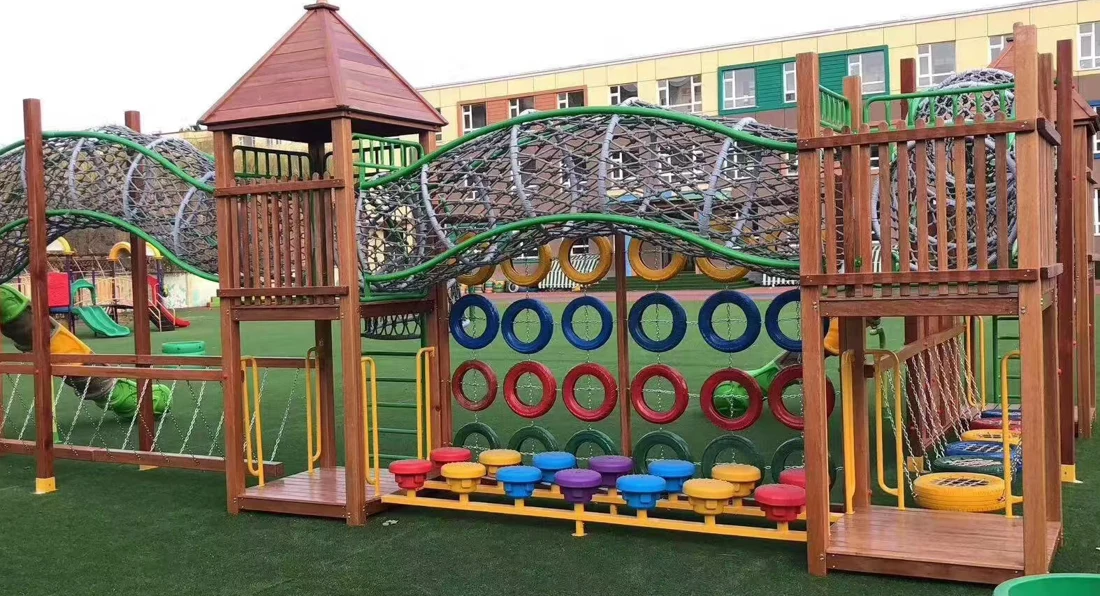
The Timber Rope Bridge Playset uses timber-led structures and rope crossings for a warmer, landscape-friendly character. PE panels are used for shaped activity details and compact products such as spring riders. Larger systems can combine metal frameworks, platforms, enclosed slides and rope connections. Xinjiu also states that anti-UV, anti-corrosion and eco-conscious options can be considered according to the product, project environment and confirmed specification.
Outdoor playground production is only one stage of an international project
For an overseas buyer, manufacturing quality and project handover are connected. Equipment may leave the factory as multiple coordinated components, while the receiving contractor needs enough information to prepare for installation and check that the shipment matches the approved scope.
Xinjiu’s service pages describe export documentation, logistics coordination, installation manuals and online technical guidance. Buyers should confirm which items apply to the specific order and destination before production is frozen. A manufacturer should not leave destination requirements until the equipment is already packed.
Destination standards should be named before the specification is frozen
Different markets can use different playground requirements. ASTM F1487 addresses public-use playground equipment within its scope and includes subjects such as materials, performance, access and egress, layout, installation and maintenance. It also excludes soft contained play from that scope. That distinction matters when a buyer purchases both outdoor playground equipment and indoor soft play from the same supplier.
The practical lesson is to state the destination market and required project documentation during the initial brief. That gives the manufacturer a chance to discuss what information is needed for the selected equipment instead of treating every market as identical. It also prevents a contractor from assuming that a requirement applying to one product family automatically applies to another.
Packing and installation planning should follow the final equipment list
A custom playground, a timber playset and several spring riders do not create the same packing or installation handover. The buyer should therefore verify the final product list, quantities, materials, finishes and delivery responsibilities before dispatch.
For a municipal contractor, the receiving team may need drawings and manuals that correspond to a one-off custom layout. For a distributor placing repeat orders, the priority may be consistent product identification and a clear record of the confirmed configuration. Both cases benefit from the same principle: shipping information should describe what was actually approved, not what appeared in an early concept.
Two outdoor project decisions that expose the difference between a catalog seller and a manufacturer
Replacing an old school play area with a mixed activity zone
A school renewal often has a fixed footprint and an existing circulation pattern. Instead of filling the space with one large structure, the project team may combine a Modular Activity Training Course with a timber playset or a combination slide. The activity course adds balance, crawl and coordination challenges, while the play structure adds imaginative routes, climbing and sliding.
The manufacturer should help the buyer see whether those activities compete for the same space or complement each other. A useful layout should also leave room for supervision and movement between zones. This is where a site plan becomes more valuable than another page of product thumbnails.
Creating a visual landmark for a new park or property project
A developer may have the opposite goal: the playground must become a recognizable feature of the landscape. A Bird’s Nest, nature-themed system or architectural slide structure may suit that brief better than a group of unrelated smaller products. The buyer then needs to consider the landmark form together with supporting equipment, circulation and the visual language of the surrounding site.
In this kind of project, Xinjiu’s custom development process is more relevant than choosing only from standard-looking products. Theme, colors, activity combinations and configurations can be discussed around the site and project goals.
How Xinjiu’s outdoor playground range can be divided by project role
| Project role | Examples from Xinjiu’s range | Where they fit best |
|---|---|---|
| Central combination structure | Robot Theme Combination Playground, Nature Theme Combination Slide | Schools, communities and parks needing several activities in one structure |
| Custom landmark | Bird’s Nest Custom Playground, Architectural Spiral Slide System | Destination parks, property developments and visually distinctive sites |
| Climbing destination | Circular Net Climbing System, Spider Web Climbing Course | Open adventure areas where climbing is a major activity |
| Landscape-led timber play | Timber Rope Bridge Playset, Timber Climbing and Net Course | Schools, parks and family destinations seeking a warmer material character |
| Supporting early-years activity | Dolphin PE Panel Spring Rider, molded character riders | Smaller play zones beside larger structures |
This division is more useful than treating every product as equal. A central structure controls the layout. A landmark controls the visual identity. A climbing system controls the challenge level. A spring rider supports a smaller zone. The project becomes clearer when the buyer knows which role each product is supposed to perform.
Before sending an outdoor playground order into production
Before production, the project team should be able to answer six concrete questions against the actual outdoor layout:
- Usable site dimensions: do the latest measurements match the drawing used to place the main structure?
- Intended users: are age groups and activity levels clear enough to separate early-years pieces from higher-challenge climbing?
- Equipment scope: does the order list match the latest approved combination of towers, slides, nets, timber play and supporting riders?
- Product-specific materials: are the timber, PE panel, molded plastic, metal and rope choices confirmed for the products that actually use them?
- Destination requirements: has the buyer stated the market and any project documentation that needs to be reviewed before dispatch?
- Handover responsibilities: are packing, logistics coordination, installation manuals and remote guidance clearly allocated for this order?
Buyers can review Xinjiu’s company and manufacturing background to understand the design-to-production workflow, then use the outdoor equipment collection to compare specific systems. For a non-standard site, the custom route should begin earlier because the equipment and the layout have to be developed together.
The strongest outdoor playground projects are not the ones with the longest equipment list. They are the ones where the main structure, supporting activities, materials and delivery responsibilities all make sense for the same site. That is the standard a contractor or distributor should use when evaluating an outdoor playground equipment manufacturer. Buyers who are comparing the supply relationship as well can continue with the outdoor playground supplier project-order guide.